Search results for: “label/bad shooting”

  • Reducing police-involved shooting & “The List”

    This past week John McWhorter and I were both (separately) on Bloggingheads.tv with Glenn Loury to talk about race and all the recent shootings. McWhorter emphasized race as a factor of those shot by police and:

    challenged those who disagree to present a list of white people killed within the past few years under circumstances similar to those that so enrage us in cases such as what happened to Tamir Rice, John Crawford, Walter Scott, Sam Debose and others.

    Well I keep track of these things and through Glenn passed some names on to Professor McWhorter. I give sincere respect to Professor McWhorter for his intellectual honesty today in Time:

    The simple fact is that this list exists.

    When a black man is killed by a cop, do we grieve more because there are 46 million of us as opposed to 198 million whites? I doubt it: most Americans never hear about the white men’s deaths at all.

    Rather, we operate according to a meme under which cops casually kill black men under circumstances in which white men are apparently let off with a hand slap — and occasional cases of just that are what often get around social media, suggesting that they are the norm.

    However, at the end of the day any intelligent engagement with these issues must keep front and center that there was a Daniel Shaver for John Crawford, a Michael Parker for Walter Scott, a James Scott for Laquan McDonald. Economist Roland Fryer’s conclusions, stunning even to him, that cops use more force against black people but do not kill them more than they kill whites is perhaps less perplexing than it seems.

    Unlike McWhorter, I was not surprised by Fryer’s conclusions. Like McWhorter, “I am neither a neither Republican nor conservative.” But unlike McWhorter, I am white. (Though I have written about some of the more egregious cases, it sounds a bit funny to say, Romney like, “I have a binder full of white people!”) I don’t want to be liked and linked to by racists and the “alt-right”.

    But I’ve researched and written about race before. I said, “The idea that police don’t use lethal force in a racist way might be a tough pill for many to swallow.” But if one wishes to reduce police-involved shootings — and all of us do; cops don’t go to work hoping to shoot somebody — there are good liberal reasons to de-emphasize the significance of race in policing.

    Jonathan Ayers, Andrew Thomas, Diaz Zerifino, James Boyd, Bobby Canipe, Dylan Noble, Dillon Taylor, Michael Parker, Loren Simpson, Dion Damen, James Scott, Brandon Stanley, Daniel Shaver, and Gil Collarwere all killed by police in questionable to bad circumstances. McWhorteradded Alfred Redwineand Mary Hawkes. You can probably find others from Washington Post data. What they have in common is none were black and very few people seemed to know or care when they were killed.

    According to the Washington Post, 990 people were shot dead by police in 2015. 258 were black. More significant than racial differences — much of which can be explained by racially disproportionate levels of violence — are stunning regional differences.

    Last year in California, police shot and killed 188 people. That’s a rate of 4.8 per million. New York, Michigan, and Pennsylvania collectively have 3.4 million more people than California (and 3.85 million more African Americans). In these three states, police shot and killed (just?) 53 people. That’s a rate of 1.2 per million. That’s a big difference.

    Were police in California able to lower their rate of lethal force to the level of New York, Michigan, and Pennsylvania — and that doesn’t seem too much to ask for — 139 fewer people would be killed by police. And this is just in California! (And California isn’t even the worst state; I’m picking on California because it’s large and very much on the high end.)

    Now keep in mind most police-involved shootings are not only legally justifiable, they are necessary and good at the moment the cop pulls the trigger. But that doesn’t mean that the entire situation was inevitable. Cops don’t want to shoot people. They want to stay alive. You give cops a safe way to reduce the chance they have to pull the trigger, and they’ll certainly take it.

    I really don’t know what some departments and states are doing right and others wrong. But it’s hard for me to believe that the residents of California are so much more violent and threatening to cops than the good people of New York or Pennsylvania. I suspect lower rates of lethal force has a lot to do with recruitment, training, verbal skills, deescalation techniques, not policing alone, and more restrictive gun laws. (I do not include Tasers on this list.)

    If we could bring the national rate of people shot and killed by police (3 per million) down to the level found in, say, New York City (The big bad NYPD shoots and kills just 0.7 per million) we’d reduce the total number of people killed by police 77 percent, from 990 to 231!

    [Update: Here are more names worth considering, taken from comments to this post: David Kassick, Josh Grubb and Samantha Ramsey(examples of officer-created danger), John Winkler, Robert Saylor. Zachary Hammond. Sal Culosi. John Geer. Autumn Steele (This is rare case of an unarmed white person shot by a black officer.) Michael McCloskey.

    Also, it turns out Bobby Canipe lived. But I’m still including him because, my God.

    And it’s well worth watching Glenn Loury and John McWhorter talk about The List in a more recent Bloggingheads.tv]
  • They’re just Sooner to Shoot in Oklahoma

    They’re just Sooner to Shoot in Oklahoma

    Updated: November 15, 2017

    Also see this 2020 update. And an important caveat.

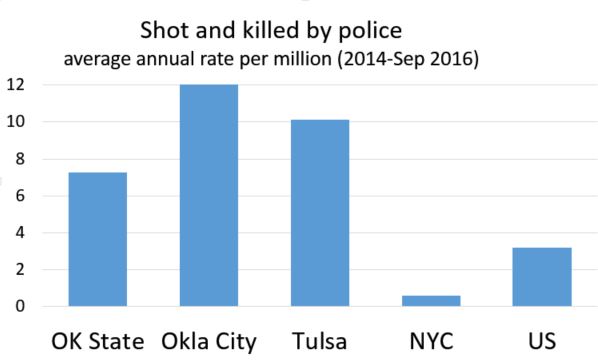
    Using data from 2014 through mid November 2017 (killedbypolice.net for 2014 and the Washington Post thereafter) Oklahoma City Police kill an average of 6.3 per year; NYPD 0.57 a year. The rate in Oklahoma City is 11 times as high. The rate per officer is 27 times higher in Oklahoma City. That means a person is Oklahoma City is 11 times more likely to be killed by police and a police officer is 27 times more likely to kill.

    Original Post:

    I’ve said for a while that when it comes to police use of lethal-force, an exclusive laser-like focus on race is misguided. It’s is a red herring. If one actually wants to reduce police-involved shootings — as opposed to simply being outraged at the latest incident — there are easier ways to do this than eliminating racism and racial disparity in America. There are low-hanging fruits to reduce the overall level at which cops shoot people.

    There will be the next police-incident worthy of outrage. We can go from incident to incident, outrage to outrage, and pretend it’s just about race. But it’s not.

    I’m not saying race doesn’t play a factor. This is American. And indeed, blacks make up a greater percent of unarmed people killed by police. The disparity could be racial bias; it could be related to violence in segregated America; it could be something else. Honestly, we’re never going to settle the debate, and I don’t know if we need to. Police misconduct doesn’t only happen to blacks. And the numbers of innocent unarmed people killed by police is simply not that large. Nor is it increasing.

    Police have shot and killed 706 people this year. Forty-one were unarmed. Fifteen of those were black. (Keep in mind “unarmed” does not mean no threat, and conversely somebody could be armed and not be an imminent threat.) I get the argument that murder is worse at the hands of the state. I even agree with it. I understand police need to be held accountable. But at some point the numbers matter, at least to put things in perspective.

    This is a country of 320 million people. There are 765,000 sworn police officers. There are 15,000 murders (and murderers). What’s an acceptable level of police-involved shooting? What’s the goal? And if you’re not happy addressing that question, or if you think the only acceptable answer is zero, than you’re not a productive part of the solution.

    Look, I know some cops do shitty things. And others make honest mistakes. But there are more cops in America than residents of Baltimore. We can and should criticize individual incidents. But we don’t harp on every crime in Baltimore — and there are a lot — to show how the whole city is filled with evil. (And I do wish we cared a bit more about victims like Michael “Chef Mike” Bates who was just shot and killed even after he complied with the three men who robbed him.)

    Does a bomb in Chelsea mean we should ban Muslims from America? (No, is the answer.) There will be the next horrific crime and the next terrorist attack just as sure as there will be the next bad police-involved shooting. Instead we’re seeing something close to a moral panic, with police as the Folk Devils, we need to reduce how often they happen.

    There are probably a few dozen bad (as in criminally bad) police-involved shootings a year. That’s a couple a month, keep in mind. And if they’re all recorded, that’s one every other week. But far more numerous are shootings which may be legally justifiable but did not have to happen. They’re justifiable but not necessary. We’re talking perhaps something in the rage of a few hundred a year. And the bulk of these happens west of the Mississippi (see a future post). The best way to reduce bad shootings is to reduce the overall level of police lethal force.

    Twenty-five percent of those who are shot and killed by police are black. Since blacks are only 13 percent of the general population, some claim this represents an “epidemic” of police violence against African Americans. But using the overall population as the denominator for interactions with police makes no sense.

    America is filled with racial disparities in poverty, violent crime, calls for police service, and those who felonious kill police officers. I mean, 96 percent of those killed by police are men, and men make up less than half the population. Is there an epidemic of misandric cops gunning for other men? I don’t think so. It’s more likely that men are more likely to pose lethal threats to police officers.

    And this brings me back to Oklahoma, where Terence Crutcher was shot and killed by a police officer even though he wasn’t an imminent threat. A while back I red-flagged Tulsa and Oklahoma because I couldn’t help but notice: they sure do seem to be a hell of a lot of police-involved shootings in Oklahoma. And now we have more data than we did a year ago.

    We’re not seeing an epidemic of police killing black people in particular in Oklahoma. The Sooner State is pretty white (72 percent, 8.6 percent Native American, and 7.4 percent black). The racial disparity in Oklahoma is pretty much in line with the rest of the nation. Since 2014, nationwide, the average annual rate of being shot and killed by police is 3.2 per million. It’s higher for blacks (6.93) and lower for whites (2.37). That’s a 3:1 ratio.

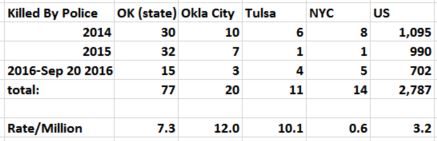
    What we see is that more white people get killed by cops in Oklahoma than all people killed by cops in majority minority New York City. Simply put, police in Oklahoma are shooting a lot of people and the NYPD isn’t. In Oklahoma, cops shoot and kill 28 people per year. In New York City, which has more than twice as many people as the entire state of Oklahoma, police kill about 5 people a year. What gives?

    People in the state of Oklahoma are 12 times as likely as New Yorkers to be killed by police.

    People in Oklahoma City are 20 times [11 times, see update, above] as likely as people in New York City to be shot and killed by police! New York City has about 2.5 times more police officers per capita. That means an officer in Oklahoma City is about 50 times more likely than an NYPD officer to shoot and kill somebody. [27 times, see update above]

    These differences are huge! Shocking! Unbelievable!

    And yet nobody seems to notice or care. [See all the states in this post.]

    I assume most of the police-involved shooting even in Oklahoma are legally justifiable. I’m not saying these cops are committing crimes, but I am saying a large percentage of these shootings aren’t necessary. They don’t need to happen. I mean, it’s likely cops in Oklahoma will always shoot more people than cops in New York City. Sometimes police have no choice but to shoot somebody. And Oklahoma isn’t New York. But it doesn’t have to be 12 or 20 times more. I can’t conceive of how a per-capita disparity this large could be justified or explained away by any variables except police training.

    So I look at the Terence Crutcher being shot, and I think: maybe that really is how police in Tulsa roll. I don’t know. And I wonder what it is about NYPD training and policy that so reduces use of lethal force. Whatever it is, and I’m sure it’s a combination of things, it shouldn’t be that hard for somebody to copy best practices. Instead of asking what individual police officers are doing wrong (though we can ask that, too), why don’t we figure out what the NYPD is doing right? We have models that work. The solution involves some combination of better hiring standards, better policy, better training, and more accountability.

    Just reducing Oklahoma’s use of lethal force to the national average would save 14 lives a year. That seems doable. And good. It’s good for the people not to get shot. And it’s good for social and racial justice. And it’s also good for police officers who get to go home without killing somebody. Cops don’t want to shoot people. You think Officer Betty Shelby wouldn’t like to go back in time and not shoot?

    And let me mention I’m only picking on Oklahoma because of the recent Tulsa shooting. Oklahoma isn’t even the worst state when it comes to high levels of police-involved shootings. Currently, in 2016, it doesn’t even crack the top five.

    [I did some brief computations on crime (some 2015 UCR data is already out!) because police violence is best predicted by public violence. In 2014 and 2015, Oklahoma has an annual murder rate of 5.4 per 100,000. This is 30 percent higher than New York City’s 4.1. Aggravated assaults and total violent crime, however, are 35 percent higher in New York City. So it seems that Oklahoma does have a violent murder problem separate from any crime problem. But nothing here would even get close to accounting for twelve- and twenty-fold differences in police use of lethal force.]

    Notes: Annual rate is based on the sum total of Jan 1, 2014 to Sep 20, 2016, multiplied by 0.367.

    2014 data: http://www.killedbypolice.net/

    2015-present: https://github.com/washingtonpost/data-police-shootings

    Oklahoma crime stats: https://www.ok.gov/osbi/documents/Crime%20in%20Oklahoma%2C%202015.pdf

    Crime stats: http://www.criminaljustice.ny.gov/crimnet/ojsa/indexcrimes/Regions.pdf

    Race data is from the Washington Post, so it starts in 2015. Annual rate is the sum from 2015 to Sep 20, 2016, multiplied by 0.58. National rates based on 318.9 million with a white population of 200 million and a black population 36 million. Feel free to double check my math. Corrections and comments always welcome.

  • “Justice 4 Whom”?!

    “Justice 4 Whom”?!

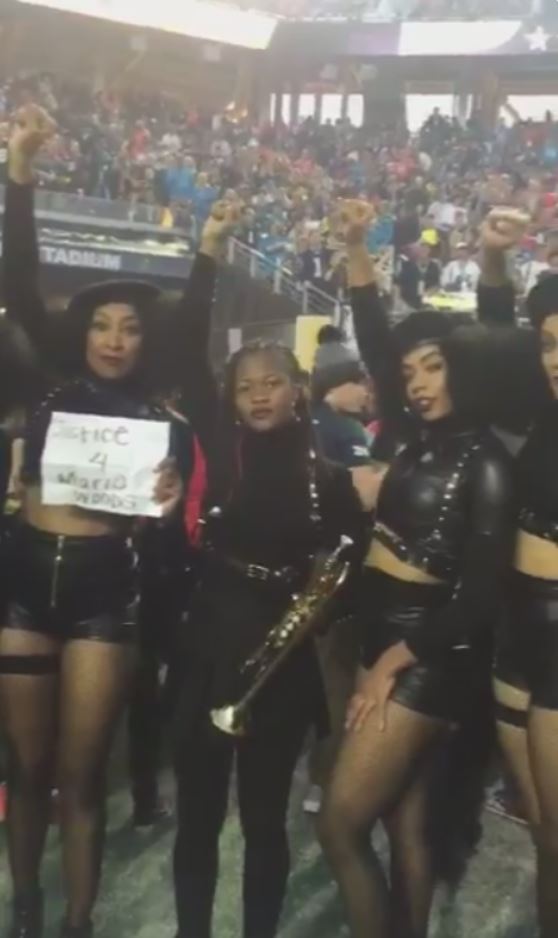
    Generally I couldn’t care less what Beyonce’s dancers think. But “Justice 4 Mario Woods” and a black power salute? Are you effing kidding me? Mario Woods was shot and killed by San Francisco police back in December. It was a good shooting.

    Christ almighty there are plenty of bad police shootings. Not this one. Woods doesn’t need justice. “Justice 4 Mario Woods” means there was an injustice done by police. But right there and then, Mario Woods was armed and dangerous and needed to be stopped.

    Crazy Mario Woods had already stabbed a stranger. And now he’s just walking down the street holding the bloody knife. Police tell him to drop the knife. He won’t. Police knew Woods had knife, had just used it, and may have wanted to use it again. Police use less lethal force… one, two, three, four, and five times. Woods won’t drop the knife even after being beanbagged and tased. It’s like he’s on a mission. (Based on what Woods said, I suspect this was suicide by cop.) If he gets closer to others and starts cutting, police might not be able to shoot. It’s a crowded street. Woods needed to be stopped.

    The Guardian, which since Coldbath Fields Riot of 1833 has published exactly one unbiased story about police, says, “Mario Woods was allegedly armed with a kitchen knife.” No. He had just tried to kill somebody. He was armed with a kitchen knife.

    One thing that bothers me about press accounts of this incident are journalists who still talk about the knife being “alleged” or the victim being “allegedly” stabbed. For legal reasons, I understand why you might throw in “alleged” when describing the suspect. But when the suspect is dead, you can drop the “alleged” crap. Dead men can’t sue any more than than they can be convicted of crime.

    The very first reporter who called me, the one who brought this shooting to my attention, mentioned almost in passing that Woods “allegedly stabbed somebody.”

    “What?” I said, “Well, that would really matters to police. He had just cut somebody? That would change everything.”

    “Allegedly,” she insisted.

    “Well, did he just cut somebody or not?!” To police, this detail would matter tremendously.

    To the best of my memory, I swear the reporter said: “Yes, but he hadn’t been convicted yet.”

    I felt like I was entering the Bizarro world of liberal media make-believe I’ve heard conservatives foam about. Did she really expect police to wait until conviction before deciding the victim was real and knife sharp? Go tell the stabbed dude he was only “allegedly” stabbed. Here’s what the actual victim did say:

    “I’m trying to get my life together. My life has been a shambles since this happened.”… “I got stabbed by someone I don’t even know and I don’t have a beef with or anything like that.”… Jacob says he is the forgotten victim, the one who was attacked and the victim protesters and city officials have ignored.

    Woods, who according to his mom and lawyer was a gentle man (of course) who was turning his life around (“He was really kind and easy to deal with and really appreciative. Terrific. Never aggressive”) had an extensive violent criminal history. He had spent nearly all his adult life in prison. Now Woods’s record doesn’t mean cops get to kill him for no reason, but it might shed some light on why Woods would do some crazy shit.