Search results for: “label/Baltimore 6”

  • 56 Rounds: What it means to “have cops’ backs”

    56 Rounds: What it means to “have cops’ backs”

    Yesterday I was asked by a journalist what it means for politicians and police brass to “have cops’ backs.” It’s a fair question. It doesn’t mean not being critical of police. It doesn’t mean defending cops when they make an unreasonable mistake. It does mean giving cops the benefit of the doubt and supporting officers when they do their job.

    Take the recent police-involved killingof a father and son in Baltimore on the 400 block of E. Lanvale (314 Post, AKA Bodie’s Corner.)

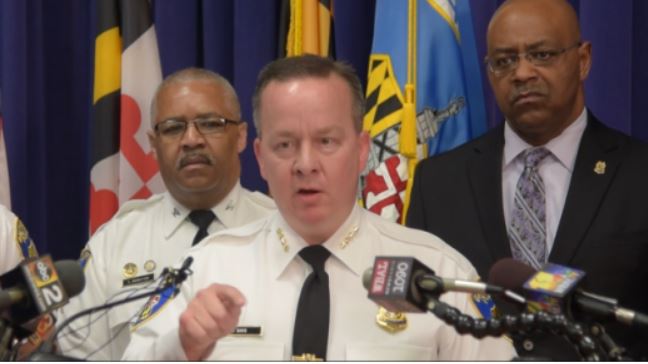
    This is Baltimore City Police Commissioner Davis having the cops’ backs (I transcribed from the video in this story):

    We had three police officers who were in the right place at the right time.

    The police came and did their job and did what they had to do.

    And I would add to that if not for the Baltimore police department yesterday, we could have had a mass shooting on our hands where several innocent lives could easily have been taken. I’m very proud of the work of our police officers yesterday. Their bravery. We can’t run from danger. We don’t run from bad guys with guns. We engage them.

    We fired 56 rounds yesterday, until this threat was eliminated. I want to put that right out there right now: 56 rounds. And you can see, and you can perhaps imagine confronting, in a neighborhood street in broad daylight, a father and son duo, with an intent to kill, that’s what it took to eliminate that threat.

    I’ll add to that, the son, one of the two men that we shot and killed yesterday, the son was out on bail for a handgun offense and the father was out on probation for a handgun offense. And that’s why I’ve personally spent so much time in Annapolis in this legislative session, in an effort to convince lawmakers, and we certainly have convinced the ones from Baltimore, about the necessity to do more with these laws and make these misdemeanors felonies. It’s about time. But that message still isn’t getting through.

    But our police officers and our community knows [sic] that unfortunately there are violent repeat offenders among us, who live right here in our city, who think nothing about carrying two guns like that in broad daylight and popping out of a car. If it weren’t for the bravery of the Baltimore City Police Department, we could be having an entirely different press conference right now.
    Kudos to Davis. You couldn’t ask for more. Now this is what one would expect from a good leader. But good leadership, especially in Baltimore, is not a given.

    Davis didn’t have to say what he said. He didn’t have to say anything. Or he could have had a spokesperson say something neutral like “we’re investigating the incident.” Or he could have raised an eyebrow by mentioning the number of shots fired before emphasizing how the “officers guns were taken immediately after the shooting and they remain on modified duty, as is departmental policy.”

    But Commissioner Davis didn’t do any of that. He went out of way to support his officers how bravely engaged with armed gunmen. This matters.

    Contrast this with former commissioner Batts who, in the name of progress and reform, threatened cops and led the city into riots and violence.

    But really contrast this with Baltimore City’s elected State’s Attorney, Marylyn Mosby, who pushes a cops-are-the-problem perspective. Her husband is running for mayor. She’s wasting her precious prosecutorial resources by prosecute good cops who may or may not have made an honest mistake.

    After this shooting, Mosby treated the officers like criminals. For the first time in as long as anyone can remember, officers involved in a good shooting were read their Miranda Rights like common criminals. For shame. These cops aren’t criminals; they aren’t suspects in “custodial interrogation.”

    Were it not for Davis and his strong and passionate words at the press conference (and also good journalism by the Baltimore Sun from which Davis quoted), it’s easy to imagine an anti-police narrative taking root. After all, this is Baltimore, where police are quick to gun down a father and son (with latter with junior-high-school graduation pictures at the ready) over a misdemeanor! (In Maryland and many states, illegal gun possession is just a misdemeanor).

    I’m sure some non-present “witness” could be found saying, “The cops didn’t have to fire all those shots. They had already given up.” Academics would criticize Broken-Windows policing. Al Sharpton, able to get a few days off work, would appear to criticize racist policing. Protesters could chant “56 shots!” while the national media returned to Baltimore and ask if (ie: hope that) more violence would be forthcoming.

    In that world, if Davis doesn’t have the cops’ backs, the next time a group of officers in an unmarked car see two guys getting out with guns? The cops could just keep on driving.

    Eventually, after the shooting stops and bodies drop, somebody would call 911.

    Would you engage armed gunmen? Why risk your life? Why face potential criminal prosecution? This is why having cops’ backs matters.

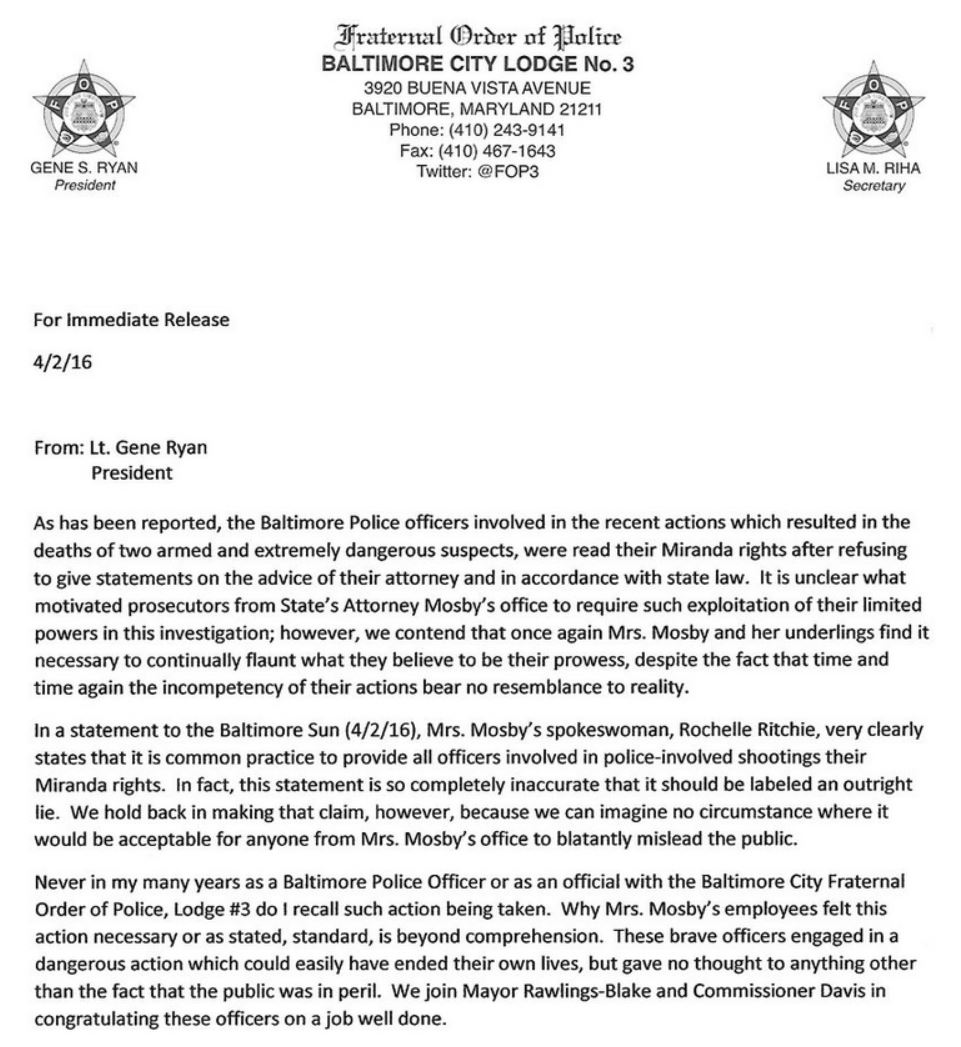
    Update: Regarding Mosby reading the cops their rights, here’s the FOP’s statement:
    2nd Update: Also, homicides year-to-date are up 25 percent this year compared to last. But given the post-riot near doubling in violence last year, being up only 25 percent from pre-riot figures is actually a massive improvement of sorts.

    3rd Update: Mosby’s office denies it. (I wasn’t there. But I don’t believe her. It’s not like she has a track record of telling the truth.) And the BPD decides not to engage. But the union will play:

    Lt. Gene Ryan, president of the Fraternal Order of Police, said Saturday that the statement from the state’s attorney’s office was “so completely inaccurate that it should be labeled an outright lie.”
  • The Freddie Gray Effect in Baltimore

    The Freddie Gray Effect in Baltimore

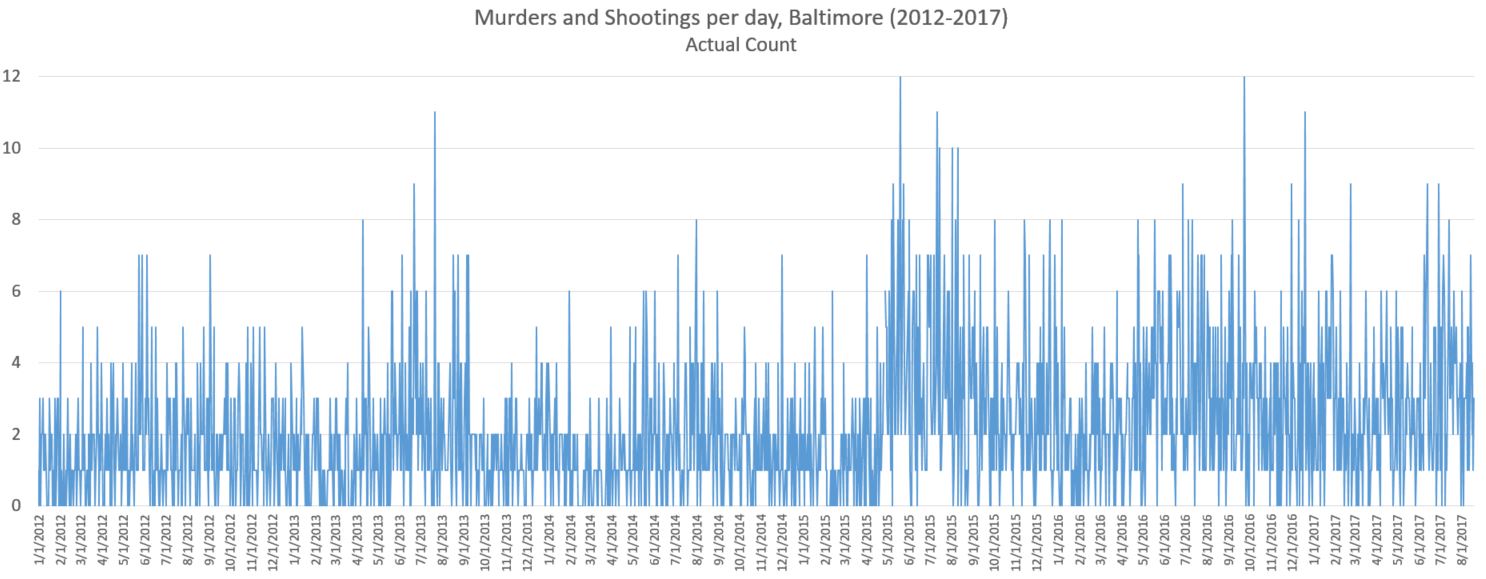
    Building on my previous post on data presentation, I did some grunt work to get a count of murders and shootings for each and every day since January 1, 2012. (If you think that’s easy or [that] can be readily downloaded, you’re wrong. Update: I could have saved a few hours of grunt work had I thought of using the  =VLOOKUP function in excel to fill in missing dates that had no major crimes.)

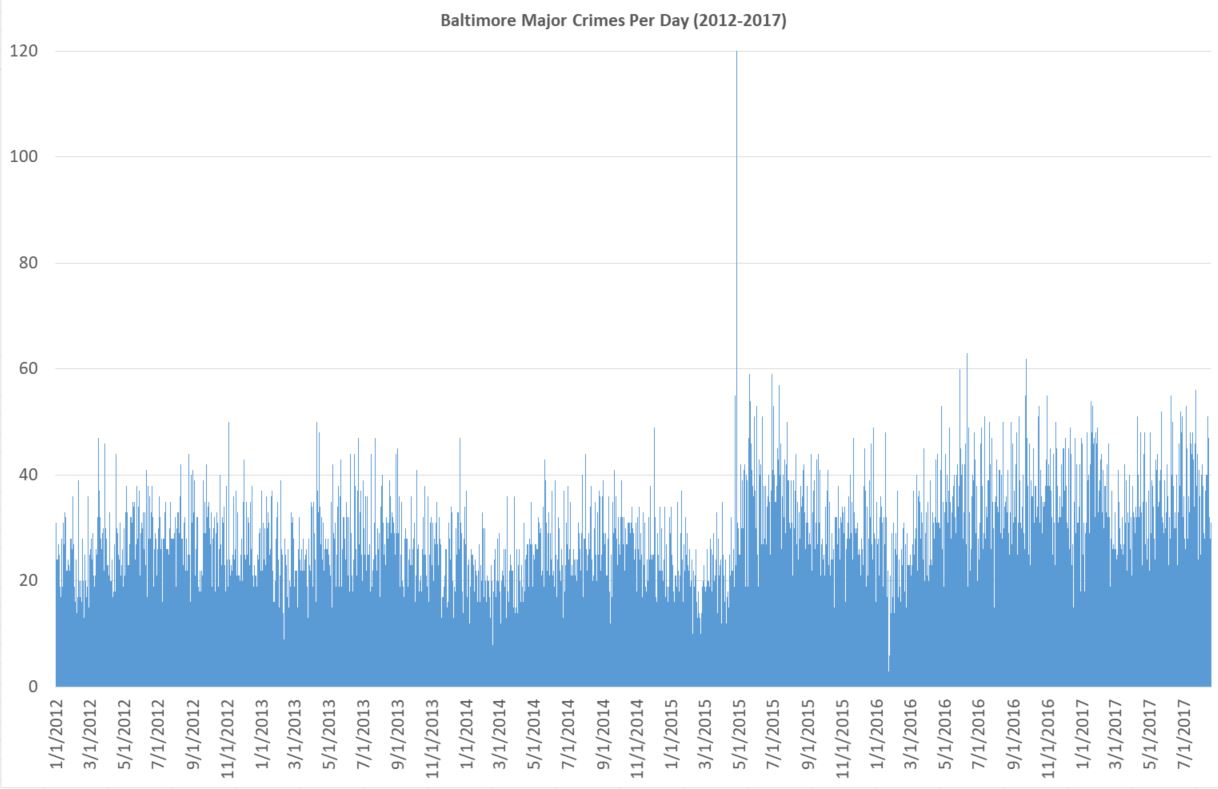
    If you simply chart the data, you get this kind of chart, which might be cool in an abstract expressionist blurry kind of way, but it’s next to worthless as a form of data presentation.

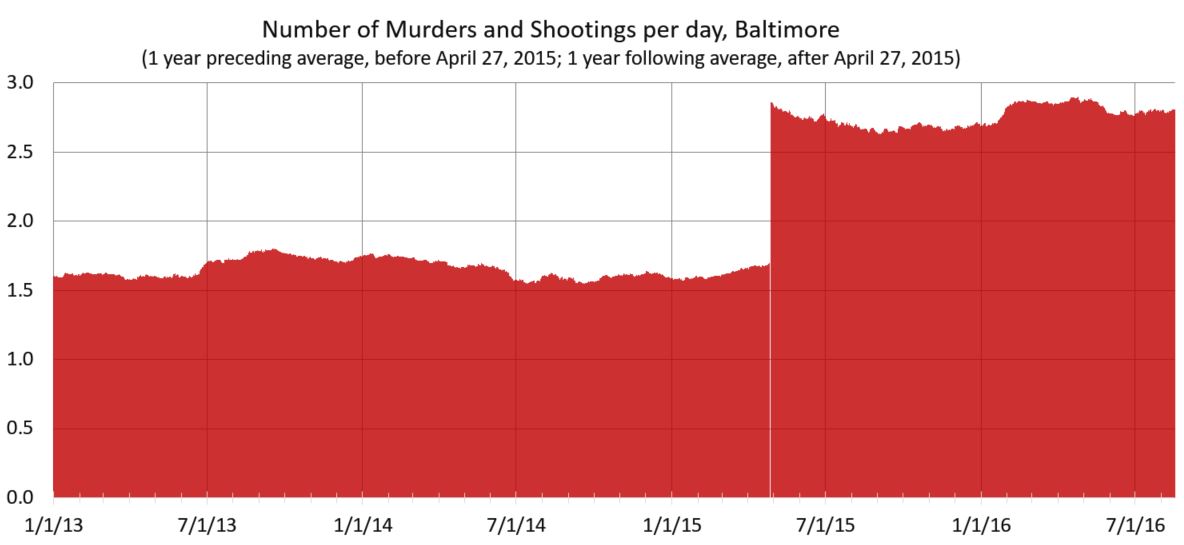
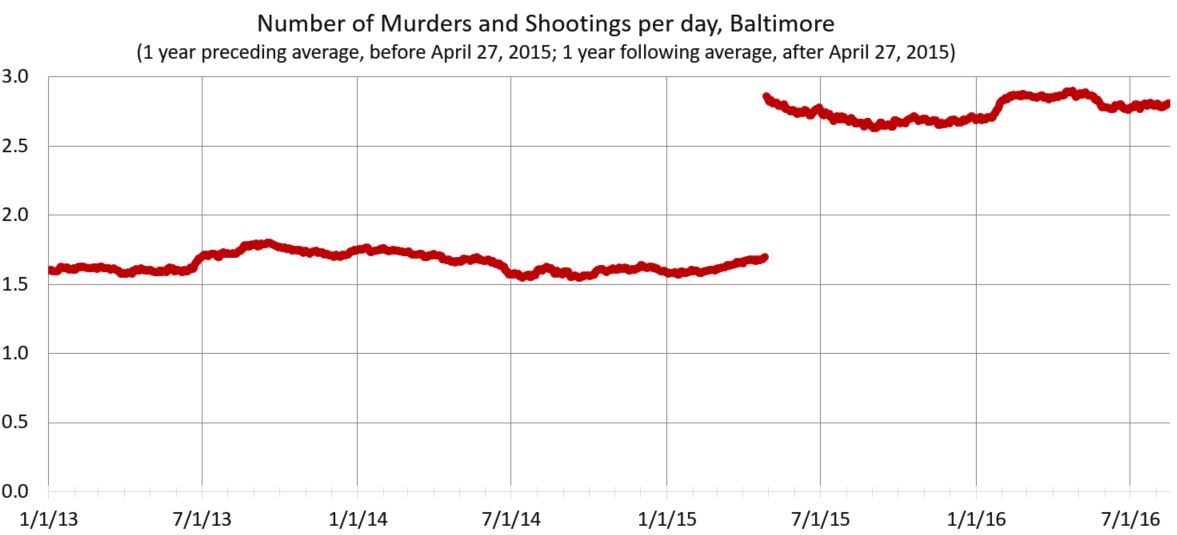
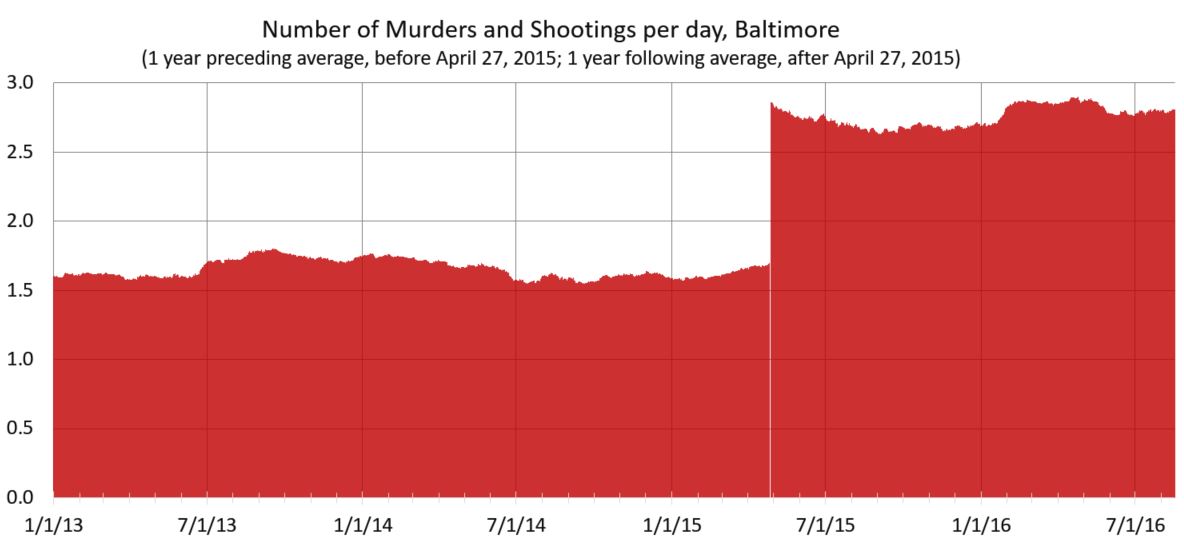
    Here’s the same data, given a bit of love and handling. For all the reasons mentioned in my previous post. I went back to a one-year moving average, split on April 27, 2015, the day of the Baltimore riots. (Pre-riot takes the average from preceding year; post-riot from the year following.) What I’m trying to highlight, in an honest way, is the large spike in murders and shooting immediately after the riots and Mosby’s decision to bring flimsy criminal charges against six Baltimore City police officers.

    Unlike other crimes, shootings and homicides are reported quite accurately. Other crimes will rise and fall in sync. (And if the data doesn’t show that, consider those data flawed, particularly in terms of less accurate reporting.) And if you’re more partial to a line graph:

    The riots were a big deal, but nobody died. More important to policing and public safety was what happened after the riots. Nobody was holding the tiller. The department was basically leaderless. The mayor had been almost in hiding. Then Mosby made the biggest mistake of all. She criminal charged six officers for doing their job — legally chasing and arresting a man running from an active drug corner (this man, Freddie Gray, then died in the police van and that led to riots). Mosby got no convictions because she had no case. She couldn’t prove a crime, much less culpability. She would later say, “I think the message has been sent.” Police got the message: if you do your job and somebody dies, you might face murder charges. Activists and Baltimore’s leaders pushed a police-are-the-problem narrative.

    Police were instructed — both by city leaders and then in the odd DOJ report city leaders asked for — to be less proactive since such policing will disproportionately affect minorities. Few seem to care that minorities are disproportionately affected by the rise in murder. Regardless, police were told to back off and end quality-of-life policing. So police did. But, unlike the arrest-’em-all strategy formulated by former Mayor O’Malley (which worked at reducing crime a little) discretionary enforcement of low-level offenses targeting high-risk offenders reduced violence a lot. It also sent a proper message to non-criminals that your block and your stoop were not going to be surrendered to the bad boys of the hood.

    Of course these efforts will disproportionately affected blacks. In a city where more than 90 percent of the murderers and murder victims are black, effective anti-violence policing will disproportionately affected blacks (Of course, bad policing will, too). The rough edges of the square can be sanded down, but this is a square that cannot be circled. Reformers wanted an end to loitering and trespass arrests. Corner clearing basically came to a stop. Add to this other factors — fewer police officers, the suspension of one-person patrol units, poor leadership — and voilà: more violent criminals committing more violent crime.

    Murders and shooting increased literally overnight, and dramatically so. Of course this took the police-are-the-problem crowd by surprise. By their calculations, police doing less, particularly in black neighborhoods, would result in less harm to blacks. And indeed, arrests went way down. So did stops. So did complaints against policing. Even police-involved shootings are down. Everything is down! Shame about the murders and robberies, though.

    Initially this crime jump was denied. Now we’re supposed to think it’s just the new normal for a city in “transition.” How about this narrative: police and policing matter; and despite all the flaws in policing at a systemic and individual level, police and policing are still more good than bad, especially for society’s most at risk. There is no reason to believe that the path to better policing much pass through a Marxist-like stage of “progressive reform” before improving. We pay police, in part, to confront violent criminals in neighborhoods where more than 20 percent of all men are murdered. We own this to those, all of those, who live there. To abdicate police protection in the name of social justice in morally wrong.

    And lest you think this rise in crime is only a problem in Baltimore, be aware that over the past three years, homicide is up dramatically in America, almost everywhere. Not just Baltimore and Chicago. Unprecedentedly so, in fact.

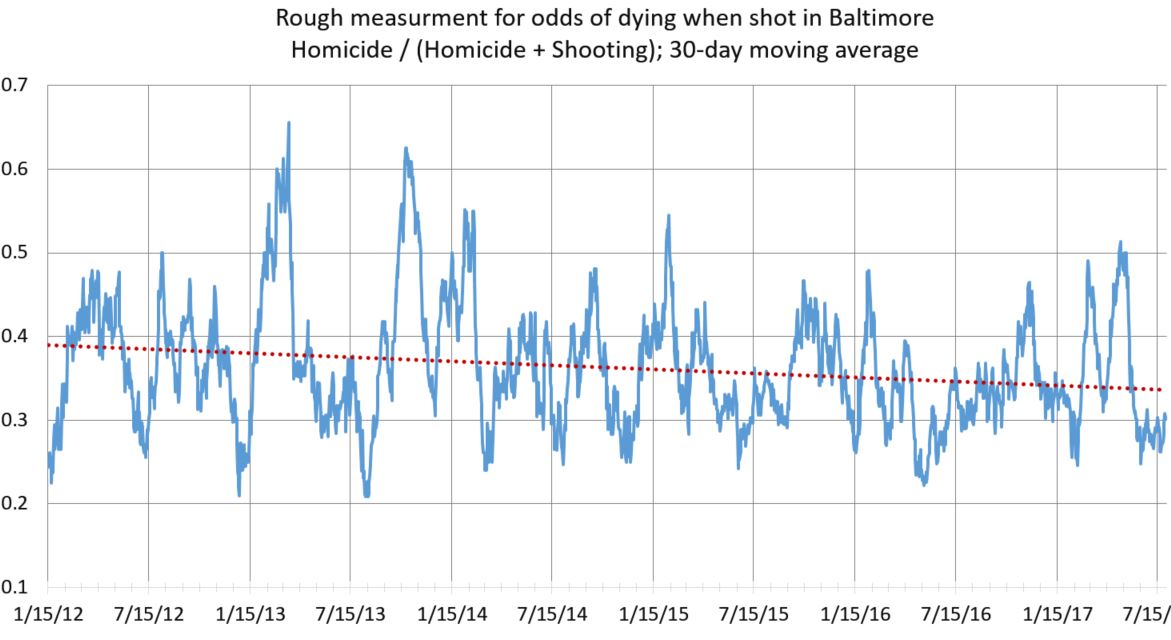
    In related news, the odds of dying if shot in Baltimore have gone down slightly since 2012, presumably because of better medical care. It’s a crude measure, but notice the downward slope of the trend line. The chance of dying has gone down from 39 percent to 34 percent. Also note the seasonal changes in mortality. I don’t know why that is.

  • Data presentation and the crime rise in Baltimore

    Data presentation and the crime rise in Baltimore

    Data presentation fascinates me because it’s both art and science. There’s no right way to do it; it depends on both hard data, good intentions, and interpretive ability. Data can be manipulated and misinterpreted, both honestly and dishonestly. And any chart is potentially yet another step removed from whatever “truth” the hard data has.

    Where I’m going isn’t exactly technical, but there’s no point here other than data presentation and honest graph making (and also crime being f*cking up in Baltimore after the riots, but that’s not my main point). If that doesn’t interest you, stop here. [Update: Or jump to the next post.]

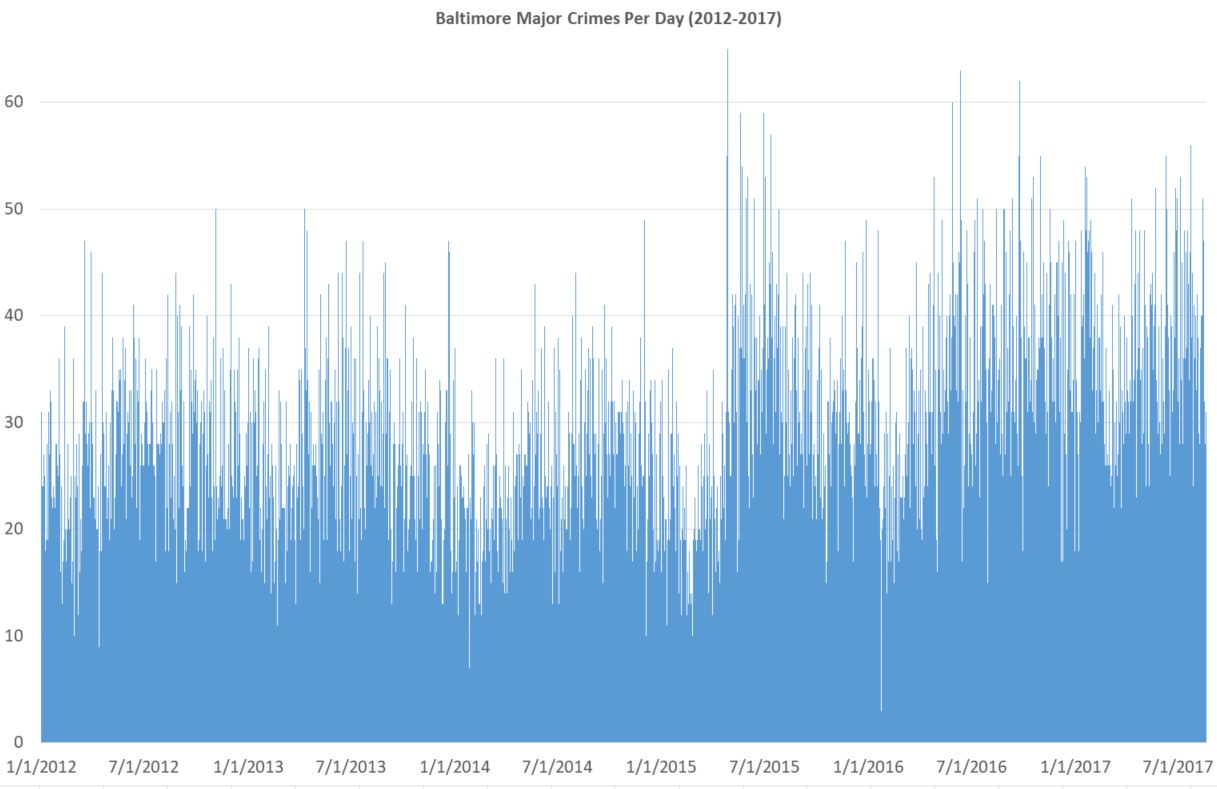
    I took reported robberies (all), aggravated assaults, homicides, and shootings from open data from 2012 to last month. I then took a simple count of how many happen per day (which is strangely not simple to simple to analyze, at least with my knowledge of SPSS and excel). You get this.

    It takes a somewhat skilled eye to see what is going on. Also, since the day of riot is so high (120), the y axis is too large. With some rejiggering and simply letting that one day go off the scale unnoticed, you get this.

    It’s still messy, but is the kind of thing you might see on some horrible powerpoint. Things bounce up and down too much day-to-day. And there are too many individual data points. Nobody really cares that there were more than 60 one day in July 2016 and less than 5 in early 2016 (I’m guessing blizzard). It’s true and accurate, but it’s a bad chart because it does poor job of what it’s supposed to do: present data. Again, a skilled eye might see there’s a big rise in crime in 2015, but the chart certainly doesn’t make it easy.

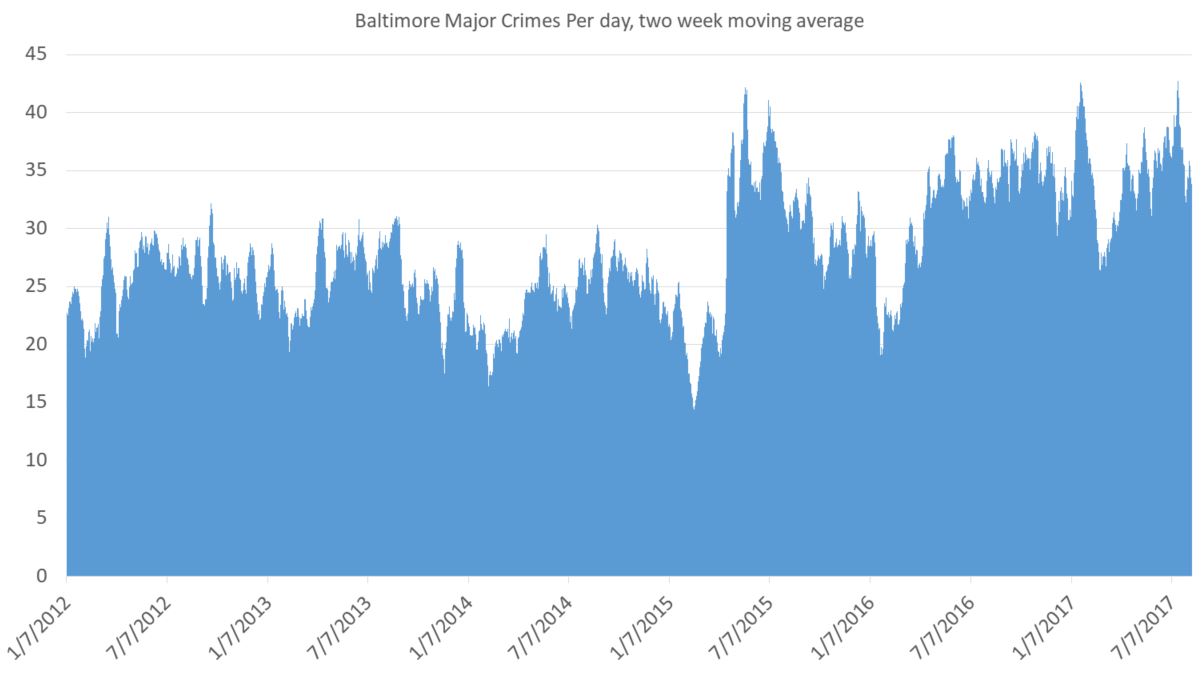
    Here’s crimes per day, with a two-week moving average. A moving average means that for, say September 7, you take Sep 1 through Sep 14 and divide by 14. Why take an average at all? Because it smooths out the chart in a good way. It’s a little less accurate literally but much more accurate in terms of what you, the reader, can understand. One downside is that the number of crimes listed for September 7th isn’t actually that number of major crimes that happened on that day. You can see why that might be a big deal in another context. But here it isn’t.

    For a general audience it’s not clear what exactly the point is. You still have lots of little ups and downs, and the seasonal changes are an issue. (Crimes always go up in summer and down in winter. And it’s not because of anything police do. And it’s nothing do to with the non-fiction story I’m trying to tell.) On the plus side, you do see a big spike in late April, 2015, after the riots and the absurd criminal prosecutionof innocent Baltimore cops. But it needs explaining.

    Also, you need some buffer for the data. The bigger the average, the more of a buffer you need. But for this I think this is one perfectly fine way to present these data, at least for an academic crowd used to charts and tables.

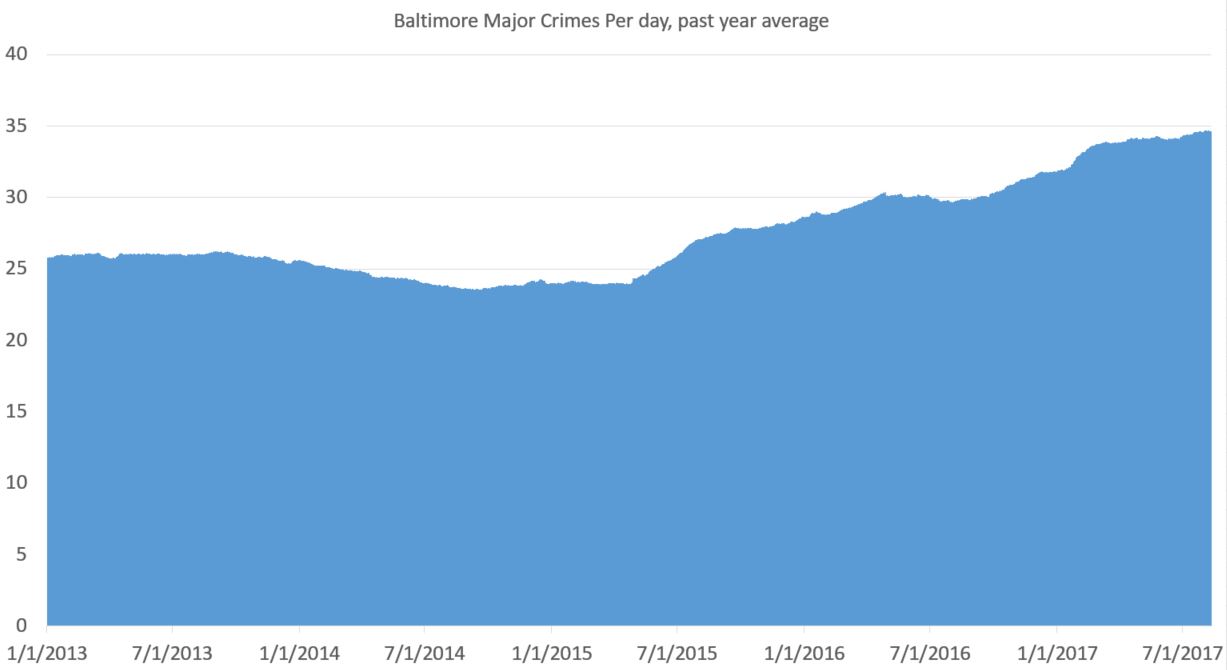
    Another tactic is to take the average for the past year. Jeff Asher on twitterover at 538.comdoes good work with NOLA crime and is a fan of this. It totally eliminates seasonal issues (that’s huge) and gives you a smooth line of information (and that’s nice).

    You can see a drop in crime pre-riot (true) and a rise in crime post-riot (also true). That’s important. Baltimore saw a drop in crime pre-2015 that wasn’t seasonal. It was real. And the rise afterward is very real. But there are two problems with this approach: 1) you need a year of data before you get going and 2) everything is muted. What looks like a steady rise (the slope since 2015) is actually a huge rise. But it looks less severe than it is because it takes an average from the previous year. But that’s not exactly true. Crime went up on April 27, 2015. And basically stayed up, with a slight increase over time.

    Here’s my problem. I want to show the rise in crime post-riot. But I want to do so honestly and without deception. But yes, for the purpose of this data presentation, I have a goal. (My previous attempts were pretty shitty.)

    Also, you need at least a year of data before you can graph anything. That’s a downside.

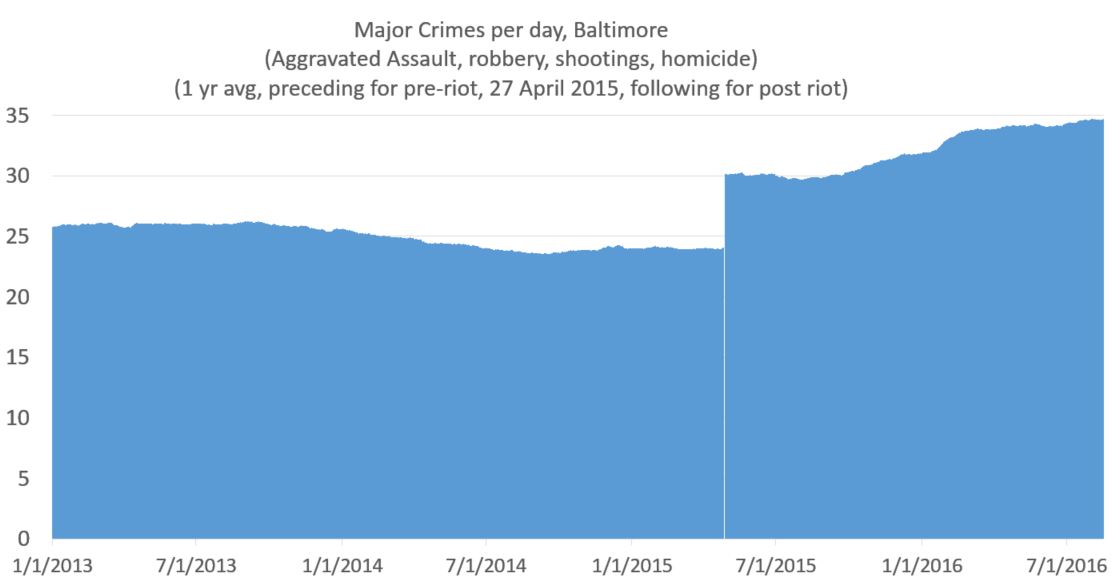
    Here’s my latest idea. If one is looking at a specific date at which something happened — in this case the April 27, 2015 — and trying to eliminate seasonal fluctuations, why not take the yearly average for the previous year before that time and the yearly average after that date for dates after that time? I think it’s kosher, but I’m not certain.

    Here’s how that works out:

    This shows the the increase that was real and immediate. And as minor point I like the white line on the day of the riot, which I got from removing April 27 from the data (because it was an outlier).

    Now if I wanted to show the increase in more stark form, I would move the y axis to start at 20. But being the guy I am, I always like to have the y-axis cross the x-axis at 0. That said, if the numbers were higher and it helped the presentation of data, I have no problem with a y-axis starting at some arbitrary point.

    Take into account that graphs are like maps. While very much based on truth, they exist to simplify and present selected data. I mean, you can have my data file, if you want it. But I do the grunt work so you don’t have to. But of course my reputation as an academic depends on presenting the data honestly, even though there’s always interpretation (e.g.: in the case of a map, the world, say scientists, isn’t flat). The point, rather, is if the interpretation honest and/or does the distortion serve a useful purpose (In the case of the Mercator Projection it was sea navigation; captains didn’t gave a shit about the comparative size of the landmass of Greenland and Africa.)

    So taking an average smooths out the line of a chart, which is a small step removed from the “truth,” but a good stop toward a better chart. It’s not a bad approach. But it tends to mask quick changes in a slow slope, since each data point in the average for a lot of days. A change in slope in the graph actually indicates a rather large change in day-to-day crime. There are always pluses and minuses.

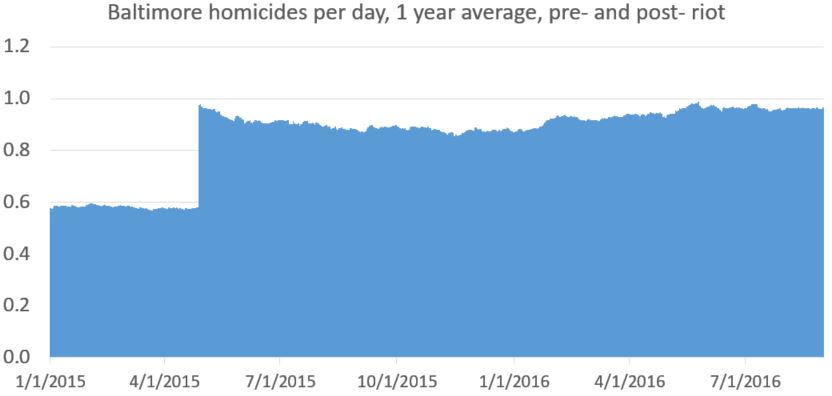
    If you’re still with me, here’s what you get when just looking at murder. Keep in mind everything up to this point has been the same data on the same time frame. This is different. But homicides matter because, well, along with people being killed, it’s gone up much more than reported crime.

    [My data set for daily homicides (which is a file I keep up rather than from Baltimore Open Data) only goes back to January, 2015. So I don’t have the daily homicide count pre-2015. 2014 is averaged the same for every day (0.5781). This makes the first part of the line (pre April 27, 2015) straighter than it should be. This matters, and I would do better for publication, but it doesn’t change anything fundamentally, I would argue. At least not in the context of the greater change in homicide. Even this quick and imperfect methods gets the major point across honestly. ]

    Update and spoiler alert: Here’s a better version of that chart, from my next post.

  • “The corrupt and brutal ones always work together as if pulled by some magnetic force”

    “The corrupt and brutal ones always work together as if pulled by some magnetic force.” (Perhaps said by a Chicago cop, but I can neither cite nor verify.) I think the reason why, might be as simple as the fact that nobody likes to be given the stink-eye by their colleagues. So if most people disapprove of what you do, you eventually get drawn like-minded folk who appreciate your work ethic and style. In the police world, for the more aggressively inclined, this means a specialized unit that focuses on arrests for drugs (and guns and maybe vice). And then, in precious semi-isolation, you feed and build on the habits of those most similar to you.

    I wrote about the federal indictment of seven Baltimore City police officers yesterday (the actual indictment is here) and said: “This is about bad apples. But it’s not just about bad apples. There’s the barrel that allows these apples to rot.”

    Who else is to blame? How do we prevent this from happening again? Who said, “Crime is up! Get me guns! And take all the overtime you need”? Who ignored complaints because the “numbers” were good?

    I don’t have the answers. But these are sincere questions. Because true organizational change best happens from within. Things sure didn’t improve when innocent Baltimore copswere criminally charged after the death of Freddie Gray. And the solution sure won’t be found in some faddish mandatory training course in implicit-bias or gender-based stereotypes. Bad reform does more harm than good. Good cops will work less; bad cops work harder.

    Last year I spent a fair amount of time criticizing the DOJ’s report on the Baltimore City Police Department. And for good reason. The DOJ report was anonymously written, horribly researched, and basically per-ordained boilerplate designed to document just enough systemic bias to activate the legal trigger needed to implement a federal consent decree while simultaneously absolving current political and police leaders of any and all accountability for the current mess Baltimore is in. These so-called investigators went to Baltimore while this crap was going on and the worst they could find were some poorly written arrest reports from five years ago?

    But I also wrote this:

    Mixed in with questionable methodology, intentions, and anecdotes, there’s some of God’s awful truth in this DOJ report. Yes, the department is a dysfunctional organization that keeps going only because of the dedication of rank-and-file who do their best, despite it all.

    I tried to highlight what the report got right. I hoped things would get better, but I didn’t think they would:

    Maybethis DOB report will improve the department despite itself. Though I might be wrong, I doubt it. I suspect people will ignore [what’s wrong with the organization] and just focus on eliminating discretionary proactive policing that saves lives. If policing has taught me anything, it’s that things can always get worse. Or, as has been said: “I have never seen a situation so dismal that a policeman couldn’t make it worse.”

    It did get worse.

    I also wrote this about the DOJ report:

    Accountability ends above the civil-service ranks. Why is that? Where is the leadership and accountability on high? Nobody blames the bosses — the mayor and police commissioner in particular — for the dysfunction of the department they control.

    You think cops like working with (the very small minority of really) bad cops? Hell, no. But the system has no way to get rid of them. So you make do. You have to.

    I defend most police officers because I’ve been there. … I’ve had to work with cops I wouldn’t trust as far as I can throw.

    So fix it, dammit. Good cops want to, but they can’t.

    And thenwe get to a failed discipline process.

    [From the DOJ Report:] The system has several key deficiencies.

    It is clear that the Department has been unable to interrupt serious patterns of misconduct. Our investigation found that numerous officers had recurring patterns of misconduct that were not adequately addressed. Similarly, we note that, in the past five years, 25 BPD officers were separately sued four or more times for Fourth Amendment violations.

    You might call that a red flag.

    How much do you want to bet that one or more of the just-indicted officers are on that list? But did anybody do anything?

    You know what might help: figure out who didn’t do the wrong thing. What you have here is an inadvertent integrity sting. Now I know you’re not supposed to get credit for doing what you’re expected to do. But you might find something out from who (if anybody) in that squad didn’t abuse overtime. Whose name didn’t come up in a wire tap? Who entered the squad, had a look around, and left right away thinking, “maybe uniform patrol isn’t so bad after all”? But that’s not the way these things work.

    [Update: According to Justin Fenton in the Sun these seven were the entire squad. As to spending your career “risking your life” to protect others as a defense, this clip from Scott and Bailey comes to mind.]

    It’s not that good cops cover for bad cops as much as they stay the fuck away from them. Why? Because if you know enough to rat somebody out, you’re already in way too deep. And if you don’t know enough, well, what are you supposed to do? Go to Internal Affairs and say, “I’ve heard rumors”? And what if some of the rumors happen to be about Internal Affairs? Nope. What you do is put on blinders to cover your ass. Why? Because when the shit hits the fan, you don’t want to be anywhere near it. This is not a Blue Wall of Silence as much as a Blue Cone of Silence. And when the bad cops are off segregated in their own unit, it makes it so much easier to see no evil. If your Spidey Sense tingles, you stay the hell away.

    And the solution — and this is always the case — needs to focus on the wrongdoers rather than be collective punishment on the majority, who are good. From my book, Cop in the Hood:

    Some officers enter the police department corrupt. Others fall on their own free will. Still others may have an isolated instance of corruption in an otherwise honest career. But there is no natural force pulling officers from a free cup of coffee toward shaking down drug dealers. Police can omit superfluous facts from a police report without later perjuring themselves in court. Working unapproved security overtime does not lead to a life in the mob. Officers can take a cat nap at 4 a.m. and never abuse medical leave. There is no slope. If anything, corruption is more like a Slip ‘N Slide. You can usually keep your footing, but it’s the drugs that make everything so damn slippery.

    As to overtime, from 15 year ago:

    To control overtime pay, superiors also discourage late discretionary arrests. While a legitimate late arrest may result in a few extra hours of overtime pay, the sergeant signing the overtime slip is likely to ask details about the arrest to confirm the legitimacy before adding an extra hour or two and giving very explicit instructions to “go straight home.”

    This “rounding up” of overtime was pretty common. And I’ll even defend it as one of the only carrots a boss has to reward somebody for doing a good job. Regardless, it is a far cry from what seems to have happened here.

  • Spin This: The biggest murder increase in 45 years

    Murder is up. Who knew? (I’ve been saying so since last October.) Eventually, we’re all going to have to accept this (not in a moral sense but in a statistical sense). The accepted liberal reaction to this increase seems to be “it’s not a big deal” and “Don’t freak out.” Let’s not get “hysterical.” Let’s talk about “gun control.” (In the early 1990s, by the way, it was all about “drug treatment.” That didn’t happen either. And crime went down.)

    What I really do not understand is why the Left is willing to concede crime prevention to the Right. (I bet Trump won’t be downplaying this in tonight’s debate.)

    False argument #1: The best violence-reduction strategy is a job-production strategy.

    It sounds nice, but I say bullsh*t. As if unemployed people just can’t help but shoot each other.

    Do not get me wrong: Poverty is bad. But it just so happens that 2015, the year with the big murder increase, also saw the biggest decrease in poverty since 1991. 3.5 million people rose out of poverty last year. That’s great news. It really is. (Full report & summary in the NYT.)

    But we still hear this from people like this St. Louis alderman:

    How do we use that [crime] data to elevate the consciousness of our community? How do we use that data to provide the opportunity for people to get meaningful jobs, with livable wages?

    No. I mean, yes! Please, work on that, too. But the question from these data is how the hell we get police back into policing and crime prevention. Sure, it sucks when dad loses his job, but consider how much worse it is for dad to get killed coming home from work. (I would even say that you can’t have a real job-production strategy until you achieve violence reduction. Who the hell is going to open a business where you will get robbed and workers get mugged walking to their car?)

    The Guardian goes on to summarize the Brennan Center’s position:

    Last year’s national murder increase was not a uniform trend, but a sum of contradictory changes in cities across the country. Early analyses of the 2015 murder increase suggested much of it might be driven by murder spikes in just 10 large cities.

    (Now I see how clever the Brennan Center was to put out their paper last week, so it becomes cited immediately to put things “in context.”)

    False argument #2: It’s just happening a few cities.

    No. It’s not.

    Homicide (and almost all violent crime) is up in every grouping of towns and cities (such as “under 10,000” and “over 1,000,000”). Period. Now that doesn’t mean it’s up in every city. But what a weird and nonsensical standard. Sure, if we remove all the places where crime is up, crime wouldn’t be up. But that’s we have fancy statistical concepts like “overall,” “in general,” and “trend.”

    Even if we were to remove the 6 cities with the largest increase — and I don’t know why we would — but just to see if the problem is isolated in a few cities, let’s take out Baltimore, Chicago, Milwaukee, Washington, Cleveland, and Houston (collectively those cities saw about 420 more murders in 2015) — even without these cities the rest of America would still have 600 more murders and the biggest homicide increase in 25 years. That’s how bad these just released numbers are.

    Now we can say that violence in concentrated in certain neighborhoods. That’s true. But we’ve long known this. Indeed, as you can tell from looking out your window, there aren’t armed marauders outside your castle gates. What matters, or at least should matter, is that more American are being murdered. I find it distasteful (particularly when it comes from the Left) to say “most people” don’t have to worry about crime because the “average person” is still safe. The fact that violence disproportionately affects a subset of Americans may indeed mean it’s not a “national crime wave,” but it is all the more reason to care.

    False argument #3: It might just be a statistical blip.

    But it’s not. I mean, it could be a statistical blip…. If it were just one or two percent. But it’s up 11 percent. The last time we saw an 11 percent one-year increase in murder was 1971. That’s exactly my entire lifetime. And that was in the middle of eight-year run when homicides doubled from ten to twenty thousand. This “blip” was literally the deaths of 1,600 more Americans. The number of people killed went up from 14,164 in 2014 to 15,696 in 2015. That one-year increase negated 5 years of homicide decline.

    If you think this increase in murder “no cause for alarm” and people who care are “overreacting,” to you, I respectfully say “go to hell.” We worked too hard to get to where we are (or were) with lower crime. And a “don’t-overreact” reaction does not help. And it may lead exactly to the right-wing law-and-order backlash you so fear. (But on the flipside, to those who don’t really care but will use these deaths to make some racist point about “black-on-black” crime and “those people,” I say with all my heart, “no really, to hell with you, too!”)

    Why I care (and why you should, too):

    Among academics, it’s quite uncool to blame criminals for crime or give police credit for crime prevention. But then how many statisticians who use the UCR Homicide Supplement can point to a specific row and say, “Yeah, I handled that one.”

    Too many who say they’re for “justice” never really have to think about the injustice of just even one real murder victim (one not shot by police). But then maybe I care because I was a Baltimore cop. Every single cop can tell you a story about a dead person. Why? Because they care. Granted, some cops do care more than others, but you can’t police and not care.

    I wasn’t a cop for long (less than 2 years in total), and even I lost track of how many victims I dealt with. But a few do stand out. And this isn’t even getting into my cop friends who were shot, killed, nearly killed, had to kill somebody, or carry physical and emotional wounds for life.

    I remember the stare of a young black man at the same track we ran around while in the academy. His backpack made me think he was a good kid, on his way home from school. He was shot, perhaps after being robbed. We made long eye contact, even though he was dead.

    I remember the guy with a gunshot to the head one 321 Post. He was still alive when I got to him. But he clearly a goner, with blood and brain dripping from the hole in his head. His sisters were wailing while he died.

    How many Harvard PhD students have the intimate experience of sorted through a victims’ clothes? Clothes that are literally dripping with blood and yet still reeking of body odor. You’re trying to go through everything, looking for pockets, for any sign of identification of the life that used to be. And then there are the death notifications.

    Think of all those deaths. Last year there were 133 more murders in Baltimore than there were in 2014. [This year the numbers are down slightly compared to 2015, and the chutzpah of some people to herald Baltimore’s “crime drop” is shocking.] Take a moment and picture all those dead bodies, almost all shot young black men and teenagers. Visually stack them up like cordwood if you wish, or lay them all head-to-toe. It’s real human carnage.

    If you took all the Baltimore murder victims from just last year and laid them head-to-toe where the Ravens play football, that line of dead bloody bodies could score six endzone-to-endzone touchdowns. And the increase in violence last year happened all after April 27th. All it took was one man’s in-custody death coupled with anti-police protests, bad leadership, a riot, and a politician’s horrible choice to press criminal charges against six police officers in the matter of Freddie Gray’s death. (All charges ended up being dropped after multiple trials without a single conviction on any charge.)

    This is actually one time I don’t care about the historical perspective. Less than the 1990’s crack-crazy murder rate is not good enough. We got down to a homicide rate like Canada (about 1/4 of ours), and maybe I’ll be satisfied. We can start caring now. Or we can start caring after a few more thousand people are needless killed. And if you think I’m over-reacting, consider that you might be under-reacting.

    [Posts in this series: 1, 2, 3, 4, 5, 6]

  • It Depends What Your Definition of “Rose” Is

    What’s your definition of “rose”? Leaving aside the one that “would smell as sweet,” mine is “goes up.” I ask because the headlinein the New York Times says: “Murder Rates Rose in a Quarter of the Nation’s 100 Largest Cities.”

    When you say homicides “rose” in 25 of 100 cities, you might think it didn’t rise in 75 cities.

    Since crime rates fluctuate from year to year, we used a statistical technique to determine places where we can definitely say rates were rising.

    A “statistical technique”? What might that be? Praytell, Times, praytell. My advanced quantitative methods are rusty (and were never good), but I’d love to know what you do.

    If the data were presented in some kind of useful fashion (they’re not) you’d see something similar to Prof. Richard Rosenfeld’s solid research (pdf link). Rosenfeld looked at 56 cities and found an increase in 40.

    You can’t really tell from the Times’ crappy graphic, but in the 70 cities “Where murder rates…,” I count 27 cities where murder rates “fell slightly.” Combined with the 5 with significant decreases, that leaves 68 of the nation’s 100 largest cities where the murder rate — what’s the word? — rose. (Which is consistent with Rosenfeld’s 40 of 56.) [It’s worth mentioning that those who write the story don’t write the headlines. In the story it’s clear that murders rose “significantly” in 25 cities.]

    Now of course as a PhD, I’m supposed to use five-dollar words when fifty-cent words will do:

    Cities are obviously heterogeneous. There is tremendous variation across the largest cities in basic features such as demographic composition, the concentration of poverty, and segregation that relate to city-level differences in rates of violence.

    O.K.

    As an academic, I’m expected to endorse platitudes like:

    There is no consensus on what caused the recent spike.

    And

    Many crime experts warn against reading too much into recent statistics.

    And I should urge restraint, lest we get carried away with caring about murder. (My fear: restraint will lead to a right-wing law-and-order backlash). Also, apparently, I’m not supposed to worry about murder until more murder is up in every damn city in America. Nor should I worry about homicide because it’s been worse in the past. (An interesting argument, I note, should one apply it to poverty, racism, lead, infectious disease, or police-involved shootings. But I digress.)

    In terms of numbers (in what I would call burying the lede):

    Nationwide, nearly 6,700 homicides were reported in the 100 largest cities in 2015, about 950 more than the year before.

    That’s a 16.5 percent increase. In one year? That, my friends, is huge. Now the nationwide percentage increase will almost certainly be smaller, but the last time there was even a double-digit percentage increase in homicide was 1968. That last time the homicide numbers increased by more than 1,000 was 1991.

    Back in January, based on less data, I guessed that 2015 would see about 1,500 more murders than 2014. Gosh, am I a swamy? No, just somebody who can remove the ideological blinders long enough to use a calculator. I even offered an open $100 bet to anybody who said, “We don’t know if homicides are up.” Nobody put their money where their mouth was. Odd. It’s like they didn’t even believe what they were saying.

    If we focused on the carnage instead of arguing about reality and methodology, you see, we’d have to consider the why? And then, perhaps, we’d notice that increased violence isn’t really linked to any change in poverty or gun laws or even legitimacy. Perhaps we’d take note, as have Professor Rosenfeld and myself, that the cities where violence is most up are the cities where police have been, to put it mildly, in the news (or even charged criminally for no good reason). Perhaps crime is up because police are doing exactly what we’re asking them to do: be less proactive and have fewer interactions with the public.

  • Paul O’Neal shot and killed by Chicago police

    Last week Paul O’Neal was fleeing from police in a stolen car. He crashed past one police car, and cops shot at him. He then veered head-on into another cop car, bailed, jumped over a fence (being more agile than any of the chasing cops), and was then shot at again. One (or more?) of these shots hit O’Neal in the back and killed him. O’Neal did not have a gun.

    I spent a few too many hours editing these videos down to an annotated good parts version. Here’s the timeline:

    0:00 1st police car passenger’s bodycam

    0:21 1st police car passenger’s bodycam, with comments

    1:47 1st police car driver’s bodycam

    2:01 1st police car driver’s bodycam, with comments

    2:50 rammed police car’s dashcam

    3:08 rammed police car’s dashcam, with comments

    It all does happen so fast. But it’s a bad shooting. And that’s before O’Neal is killed. The bottom line is that the first cop who shot — the passenger in the first police car struck — shot too quickly and unreasonably. His actions directly led to O’Neal’s death by creating what is known, in technical police circles, as “a complete clusterfuck.”

    This cop fucked up in so many different ways, it’s hard to count the ways. But I came up with eight, for starters:

    1) His gun is unholstered in the car (WTF?) before he even gets out.

    2) He shoots without an imminent threat to him or his partner.

    3) He shoots one-handed, while moving, without trigger control.

    4) He shoots at a moving vehicle (which goes against department policy).

    5) He came damn close to shooting his partner!

    6) Twice!!!

    7) He shoots at a fleeing felon (which goes against Tennessee v. Garner).

    8) He shoots downrange toward a light-flashing police car coming in his direction.

    And for what? A stolen car?

    And after the shootings, his most-vocalized worry was:

    Fuck, I’m going to be on the desk for 30 goddamn days now. Fucking desk duty for 30 days now. Motherfucker.

    Don’t worry. You won’t be sitting at a desk for long. You’ll be criminally charged with something, as you should be. Probably convicted, too. And I hope you’re fired for shooting at other cops. No cop will work next to this trigger-happy shooting-at-his-partners cowboy. The other officers on scene could only be so lucky if it turns out that the fatal bullet did come from his gun. See, despite having fired at at least 10 times, Officer 30-Goddamn-Days can’t be convicted of homicide because he probably never hit O’Neal! It would be fitting if they made him pay for the bullet hole in the car.

    The officer who fired the fatal shot probably shot O’Neal in the backyard, and there’s no video of this. He or she will have a reasonable defense. They had good (albeit incorrect) reasons to believe O’Neal was armed, dangerous, and shooting at cops. O’Neal was a felon who rammed a cop car head-on. The irony is that Cowboy Cop, by shooting, makes the subsequent officers’ actions more reasonable.

    This could turn out like the police-involved shooting of Amadou Diallo: a tragedy, a bad shooting, and a collective fuck-up, but still not a convictable criminal offense for cops thinking they’re under fire. “Reasonable” is the legal standard. (But it doesn’t do justice to Diallo to compare these shootings. Diallo’s death was worse because Diallo was innocent, compliant, not in a stolen car, and not fleeing from police.) This won’t be as open-and-shut obvious acquittal as, say, homicide by failure to seatbelt. But cops don’t have to be right; they have to be reasonable. And criminal cases need to be proved beyond a reasonable doubt.

    And yes, it should be said: kids, don’t steal cars!

    [I first saw the videos on Tanveer Ali’s article in DNAinfo. Unedited videos can be found at Vimeo under Log# 1081642.]

    [The one “good” shot, in my opinion, comes from the driver of the first police car. He gets out of the way of the car coming at him and takes fire (turns out from his stupid partner, but he didn’t know that). What he does know (even though it turns out to be wrong) is that a felon is shooting at cops and driving toward more police officers. You can shoot at a vehicle if you believe that vehicle to be an imminent threat is a form other than the vehicle itself. (The police passenger knew the car thief wasn’t shooting, so his shots were not good.) The police driver assumes a good shooting stance, aims, and fires once (or maybe twice), hoping to hit the driver in his back. Given what he knew right there and then, it’s a good shooting (even with the cop car downrange, but off-target). This is not the same as saying his shooting was right in hindsight. It wasn’t. But shootings can be legally justifiable even when hindsight proves them wrong.]

    Update (January 12, 2018) from the Chicago Tribune:

    Two Chicago police officers should be fired for shooting at a moving vehicle without justification during a chase and fatal police shooting in 2016, disciplinary officials ruled in a report obtained Friday by the Tribune.

    Officers Michael Coughlin Jr. and Jose Torres endangered the public and the lives of their fellow officers when they shot at 18-year-old Paul O’Neal as he tried to flee police in a stolen Jaguar convertible on a residential street in the South Shore neighborhood, according to the report by the now-defunct Independent Police Review Authority.

    The same report concluded that a third officer, Jose Diaz, who ultimately shot and killed O’Neal during an ensuing foot chase, was justified because he reasonably believed that O’Neal had a gun and had already fired shots at the police, even though O’Neal turned out to be unarmed.

    It was recommended, however, that Diaz be suspended for six months for kicking O’Neal and yelling “Bitch ass mother——, f—— shooting at us!” while the teen lay mortally wounded in a backyard.

    That same profanity-laced statement, which was captured on a police body camera, convinced investigators that Diaz “genuinely believed” at the time that O’Neal had fired at him, according to the report, obtained by the Tribune through an open records request.

    Further update, October 2018. Looks like both officers are going to be fired.

    Further more update, March 2020. They are being fired. I can’t believe it’s 4 years later.

  • Why fewer police-involved shootings in Chicago might be bad

    Why fewer police-involved shootings in Chicago might be bad

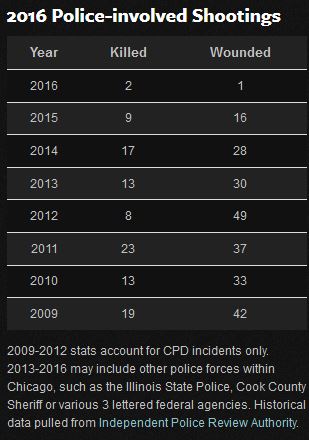
    Police-involved shootings in Chicago are way down.

    From heyjackass.com

    This is great news for advocates of police reform.

    Chicago in 2016 will probably see police shoot just 15 or so people (based quite sketchily on January through March figures). This compares to 45 people shot in 2014. The decrease is without doubt due in part to those who keep a laser-like focus on police misconduct. The number of those shot by Chicago Police has plummeted for two consecutive years.

    But it’s also very likely that Chicago will see close to 3,500 people shot this year. That would be 500 more than 2015. And that was 500 more than 2014. And that was 500 more than 2013. And for each 500-person increase in shootings, roughly 480 victims are black or hispanic.

    What if — hypothetically of course and absent any corresponding decrease in violence in general — what if police-involved shootings served as a proxy (an indirect indicator) for police officers’ engagement and interaction with violent criminals and the criminal class? It’s not inconceivable. Another indicator is that police stops in Chicago have also plummeted.

    In the police world we’d call these facts “clues.” Of course in the academic world I’m “just guessing.” But I’ll have a lot of time to guess before “hard social science” (that’s a joke, by the way) can prove what’s going on.

    But hey, why focus on the negative? Why focus on criminals and dead young black and hispanic men when we can just keep the heat on police? Let’s assume heroic police behavior is criminal. Let’s criminally prosecute innocent cops and drive other cops who defend themselves into hiding. Let’s build a social movement on (what turns out to be) a lie and then pretend it doesn’t matter because, well, it could have been true. And then, when police do less and crime goes up, deny it. And then, when you can’t deny it any longer, say we don’t know why crime is up. Or better yet, blame the police.

    But police-involved shootings are way down!

    Update: here’s the same data but compiled on June 6:

  • Courage, not fear

    I still can’t believe this guy got shot down by a cop playing whack-a-mole with his service weapon. The D.A. said:

    The evidence in this case shows the shooting to be accidental, and possibly negligent, but not criminally so. “This shooting is not justified, but also not criminal.”

    I don’t know if I buy the stutter-step no-double-tap explanation. But at least the legal concept is sound. Something can be wrong and not criminal.

    In fact, the only charges are against the paralyzed victim with the dead wife. [Update: Charges were dropped. He died.] This seems kind of mean. And there are no national politicians weighing in. Just a small local protest. Al Sharpton must be previously engaged. (As is often the case, this unnecessary shooting happened in California.)

    Officer Feaster claims he didn’t know he shot Thomas:

    No, no. … I don’t think I shot him. I wasn’t even pointing at him but the gun did go off.

    Did go off“? What are you saying? It just blew?

    Let’s leave aside whether Feaster is the world’s best shot or the world’s worst cop. Perhaps it doesn’t matter. The question I have, the question any reasonable police officer might have, is why the hell did he draw his gun in the place. What made this cop so afraid that he felt the need to approach a crashed presumed drunk driver with his gun drawn and shot the man trying to get out of the wreck? The guy was going to run? What use is your gun in that case? A car just flipped. What exactly was the threat?

    In the same vein, a reasonable police officer wonders, as did Levar Jones complying with orders, why he got shot. Why did cops feel that innocent Jonathan Ayers was a lethal threat while driving away? Why is a man not carrying a gun a lethal threat when he drops his hand?

    Why did all these police officers see non-existent threats? Why were they so damn afraid? (I’m tempted to add “…these days,” but maybe it’s always been this way. I don’t know.)

    In the face of danger you need to act but not overreact. You need courage, not fear. There’s a line I always liked in Birds Without Wings:

    His courage was not the foolish kind of a young and silly man. It was the courage of a man who looks danger in the face, and forces himself not to flinch.

    Hell, a little fear can be a good thing; you don’t want to be blasé in the face of danger. It starts in the police academy. “Stay alert, stay alive!” It’s a good lesson. Even “make a hole” isn’t so bad when it’s put in the context of situational awareness. But too much fear becomes paranoia. And that’s not conducive to good policing (or a happy life).

    Here are some of the videos cops watch in the police academy. Some I saw myself. Others are more recent. They’re all on YouTube (which didn’t even exist when I was a cop). I guarantee you that every last one one of these has been watched in some police academy somewhere. Every cop I know knows 1) Dinkheller.

    And 2) here’s that woman cop getting her ass kicked trying to arrest some big guy. His daughter is there. The cop kind of came back, but never recovered.

    Go on. Watch them. Watch them all. It won’t take but 10 or 15 minutes. I’ve cued them all up to the key moment. It’s a parade of snuff films (though many of the cops do live, somehow). Can you watch all of these and not perceive threats and car stops a bit differently?

    3) Here’s a man who wouldn’t stay in his car.

    4) Here’s a routine traffic stop.

    5) Here’s another routine traffic stop.

    6) And other routine car stop.

    7) This was a routine car stop but the guy drove away.

    8) Here’s a guy in cuffs and a girl. What could possible go wrong?

    9) Three cops. One suspect. Everything under control?

    10) This guy isn’t wearing a shirt and doesn’t seem hostile.

    11) This guy is naked and unarmed. There are three cops, two of them with tasers. The guy is still a threat.

    12) And sometimes this happens. Things can go from 0 to 100 really quickly.

    13) This guy does a little jig. He must be just be an odd character.

    14) And everything seems OK here. Except for that shot cop.

    15) This is what happens when you don’t put suspects on the ground.

    16) We all know that when it comes to an armed man, it’s easier to act than react.

    17) And people who have done time can be especially dangerous.

    18) Out-of-shape fathers with their 16-year-old sons? Could always be cop killers.

    And to cops these aren’t just abstract videos. There are people I know, friends, some taught in the academy, who were shot and lucky to live. Others, the pictures on the walls, weren’t so lucky.

    Certainly cops need some of this. Some people are willing, even eager, to kill police. You can’t go on the job as a pacifist. But at some point fear isn’t healthy. It isn’t good for the job. It can even make the job less safe.

    And I worked in a dangerous post. It made me less afraid. You face danger a few times, and you learn to respect it. Cops in the Eastern don’t squeal every time somebody steps on a leaf. But you don’t shoot at everything that moves.

    But what if your work in some place without much danger? How do you stay awake, much less alert? (In my squad we could be alert and asleep!) And then, during some “routine” traffic stop or domestic — blam — something goes off script. Maybe you, the young cop who took the warrior mindset to heart, get a flashback to one of those videos in the academy where the cop got ambushed. And you think: “This is exactly how that cop got killed.”

    [Cue trippy flashback music and echo]

    “This officer hesitated [tated] and it cost him his life [life, ife, f…]”

    “Better to be judged by 12 [elve] than carried by six [six, ix, x…].”

    So you misidentify a threat, overact, and pull the trigger. You’ve screwed up because you’ve gone through life in a constant state of “Condition Yellow” because you didn’t want to slip into unaware “Condition White” in which:

    You may very well die — unless you are lucky. I prefer to not depend on luck.

    Some insist you cannot go through life using this system without becoming a hair-trigger paranoid person who is dangerous to ones self and others. I believe well-adjusted police officers can run through the color code dozens of times every day and be no worse for wear. Most experienced police officers who learn the color code realize they have been taking these steps on their own all along.

    Maybe. For some. For me even. (This is why cops don’t sit with their back toward the door.) But even if constant hypervigilance doesn’t make you paranoid, it is very tiring. Exhausting, even. I don’t miss it. And stress affects some people more than others. NYPD officers are much more likely to commit suicide with their service weapon than be killed by a criminal. Why?

    I don’t know the answer. I don’t like the “warrior” or “guardian” dichotomy. I would certainly put the emphasis on the latter, but you need a bit of both. You can’t let the warrior mindset take your soul.

    Seth Stoughton writes in the Harvard Law Review:

    Officers learn to be afraid. That isn’t the word used in law enforcement circles, of course. Vigilant, attentive, cautious, alert, or observant are the terms that appear most often in police publications. But make no mistake, officers don’t learn to be vigilant, attentive, cautious, alert, and observant just because it’s fun. They do so because they are afraid. Fear is ubiquitous in law enforcement.

    And to those who say police need to abandon this warrior mindset for guardian mindset. Well, they’ve got an answer for that, too. And it’s not crazy. What do you do when it’s time to fight?

    At some basic level policing does involve confronting and fighting criminals intent on hurting you or others. I always notice that when people talk about police reform or improving community relations, the word “criminal” will never come up. It’s as if the entire job of policing is nothing more than dancing with kids and smiling at church-going ladies in fancy hats.

    See, just as the public needs to have a more realistic perspective about the “epidemic” of police killing innocent people (happens, but not too much), police need to get a realistic grip about being shot on the job (happens, including to friends of mine, but still less than cops think). Nationwide police get shot and killed about 3 times every month. That’s an annual homicide rate (cops getting killed per 100,000 officers) of under 5, which just happens to be almost identical to the national homicide rate. Of course keep in mind cops are on-duty only a fraction of the time, so cops on the job have a homicide rate 5 times higher than the national average. But hell, it’s still safer to be a cop than to live in Baltimore.

    Stay alert. Stay alive. But for God’s sake stop being so damn afraid all the time.

    [In memory of the police officers killed in the above videos: Kyle Wayne Dinkheller, Jonathan Richard Schmidt, Edward Scott Richardson, Billy Colón-Crespo, Ramón Manuel Ramirez-Castro, Darrell Edward Lunsford, Sr., Thomas William Evans, and Robert Brandon Paudert. They gave their all.]

  • Choose your own adventure! The sick prisoner. (page 8)

    You’re a good officer. But these assholes are always lying. Who knows why they always fake it, but they always do.

    You get to Central Booking and the woman at the gate asks if your prisoner is OK. You look in the back and see the prisoner slumped over in the seat. You immediate call for an ambulance. But it’s too late.

    Your prisoner is dead.

    After public protests, you are criminally chargedwith 2nd degree depraved heart murder, misconduct in officer, second degree assault, involuntary manslaughter, manslaughter be vehicles, and reckless engagement.

    Even if you get off on the charges, which seem rather harsh for an honest mistake, your career is over.

    THE END.

    (start over?)