Search results for: “label/DOJ report on BPD”

  • Suddenly It Became His Job

    Suddenly It Became His Job

    Well done, Officer Rogers!

    “An officer was actually on this block on another call and actually heard the shots being fired, said T.J. Smith, Baltimore City Police Spokesman. “That officer gave pursuit.” How often does that happen? And what exactly happened? An edited and shortened version of the bodycam footage had been acquired by WMAR, which made me go, “damn!” I asked T.J. Smith if I could view the entire footage, and he was kind enough to post it publicly.

    Here’s what happened. [There’s a timeline, below.] On April 19, 2018, at approximately 15:00 hours, Officer Rogers responded to a 311 call for a landlord-tenant dispute at 1704 N Regester. Probably something like, “landlord says tenant refusing access to her building. Please see Miss Whomever.” The 1700 block is a small block in my old sector. Six homes are boarded up.

    Many calls are for disputes that are not or should not be a police matter. It’s not his job. In civil matters, there’s very little the police can or should do. In Baltimore, as in many places, the sheriff’s office handles law enforcement related to housing issues. [This actually takes a great burden off police, who otherwise would have to be seen as taking take sides in evictions and like.]

    The landlord tries to make it Officer Roger’s matter by saying she has been threatened by the tenant. There’s some debate about “street talk” at if “going all gangster” is a threat. But the officer wisely won’t play this game. Presumably he’s got other calls to answer. It appears he’s already out of sector handling this kind of nonsense.

    [My take: Apparently the furnace broke. That’s a housing violation that needs fixing. Now there is something about hot water, too. The tenant reports this to the city so that he would have legal reason to stop paying rent. But, and here’s the catch, the tenant doesn’t want the violation fixed because as long as the status quo can be maintained, he’s living rent free! So the tenant decides he won’t let the landlord in. The tenant also says he’s moving anyway, which is news to the landlord and no doubt will coincide with the problem being fixed. The landlord says he owes her money. She isn’t going to get it. Yes, this is why people don’t want to be landlords. And basically as a cop you just want to make sure everything is just calm enough — basically that they won’t start fighting — so you can get out of there. Often the show to which police officers have a “front-row seat” is something not worth the price of admission. Again, this isn’t his job.]

    It’s all very boring and typical. And it lasts for 7 minutes. Just as the officer is looking for a way out, boy does he find one. Gunshots ring out (7min:48sec). There are 15(?) shots in five seconds. Less than two seconds after the first shot rings out (and three seconds before the last shot) Officer Rogers takes off running, toward where the bullets are coming from. Yes, that is what most cops do.

    Walter Baynes, a 30-year-old black male, had just been shot and killed, and George Evans, 69-years-old, reported to be Baynes grandfather, was shot and wounded. One of them, I presume Baynes, had a gun on him when he was shot (13:23). The gunshots sound like they come from one gun, at least to my ears. But given the number of shots fired, it’s possible that Baynes also emptied his revolver at the man who shot and killed him with a semi-automatic. If so, Baynes missed.

    In the video, notice how the people, except for the officer, barely react to gunshots. And just a minute later it’s like things are back to normal. Traffic doesn’t stop. People walk by like nothing happened. Not even a reason to interrupt your dog walk (9:44). People act like it’s routine, because, unfortunately, it is. Sixteen of Baltimore 122 murders this year (to date) have been in the Eastern District. Many more get shot and live.
    Such brave, good police work is also routine. An officer runs toward gunshots and single-handedly confronts a man whom he believes to be armed, a man who just killed a man. He does this by instinct and training. He does this not necessarily because he wants to, but because it is the right thing to do. Because running toward danger is his job. He did good, Officer Rogers did. Very good.

    And then, after all this, all he wants to do is check his bodycam footage to see if the suspect is on it. If it were up to the ACLU and the police-are-the-problem set, police wouldn’t be allowed to do so. That’s crazy. Also, it takes 15 long minutes before somebody will watch the suspect so he can do so.

    Good police work doesn’t go viral like a video of bad policing or a cop doing something stupid. And if all people see are videos of cops shooting black men, they start believing that shooting black men is all cops do. So let’s play the counterfactual game and imagine this went down differently. Let’s say at 8:10 in the video the suspect made a move toward his waistband. Or maybe he didn’t. Either way, let’s say the officer shoots and kills the suspect. Would this be legally justifiable? Probably. Would it be correct? Well that depends if the suspect is armed. Can you tell if the suspect is? I cannot.

    It turns out the suspect isn’t armed, at least not at this moment when he’s caught by police. So now you would have a scenario in which a bad cop has shot and killed an unarmed black man. In Baltimore, no less. Oh, that would go viral. Doesn’t matter if the guy just killed somebody. The gun used to murder Mr. Baynes? Probably ditched in the alley and picked up by somebody else before it even bounced. Doesn’t matter if the cop is African American (implicit bias and all). There would be protests and perhaps worse.

    No matter what would happen now, the officer’s life is ruined. Career over. Thrown under the bus by the department. He and his family will receive death threats. Perhaps they will have to go into hiding. A criminal prosecution would likely occur. Mosby has tried to convict cops for a lot less. All because this officer ran toward gunshots and misperceived a lethal threat. Harsh.

    Should any single split-second decision really be the difference between a narrative of brave hero police officer and protests over an evil criminal cop who is now the only person from this incident on trial for murder? Perhaps we demand too much. We all make mistakes. What was the officer’s intention? Well, to apprehend a shooter. It was not to kill the suspect, though he was prepared to do so.

    Watch the video in real time, between 7:48 and 8:10. We’re talking a total of 22 seconds. How would you react? Of course you might reasonably say, “I don’t know. It’s not my job to react. I’m not a cop.” Ok. So let me ask this: how do you want police to react? Just as this cop did, right? Run towards gunshots, chase a suspect, and not shoot anybody, not even a bad guy. Job well done, right?

    Nope. Not so fast.

    See, the DOJ report on Baltimore Police, the one that opened the door to the consent decree, the one written by “progressive reformers” who have never let lack of police experience get in the way of telling police how to do their job, that report? Well it says Officer Rogers did it wrong. I mean, what if somebody got hurt?

    If circumstances require that the suspect be immediately apprehended, officers should contain the suspect and establish a perimeter rather than engaging in a foot pursuit, particularly if officers believe the suspect may be armed.

    You’re kidding me, right? I don’t even know what “containing” a suspect means, much less how you would go about setting up a “perimeter” to do so. This isn’t idle talk. Last month in Seattle, because of a consent decree, an officer faced discipline for successfully subduing a man with a axe. If police get in trouble for making decisions and acting in the face of danger, there’s really no point to having police at all. And that, of course, might be the “progressive” vision.

    Luckily, back in the real world, we’re left with the happy narrative of a brave officer who risked his life to apprehend a murder suspect. And luckily, in this case, no person-of-color was shot or killed at the hands of police. (Which seems to be just about the only thing reformers care about. The fact that two African-American men were shot, one fatally, doesn’t seem to register much with the “woke” set.)
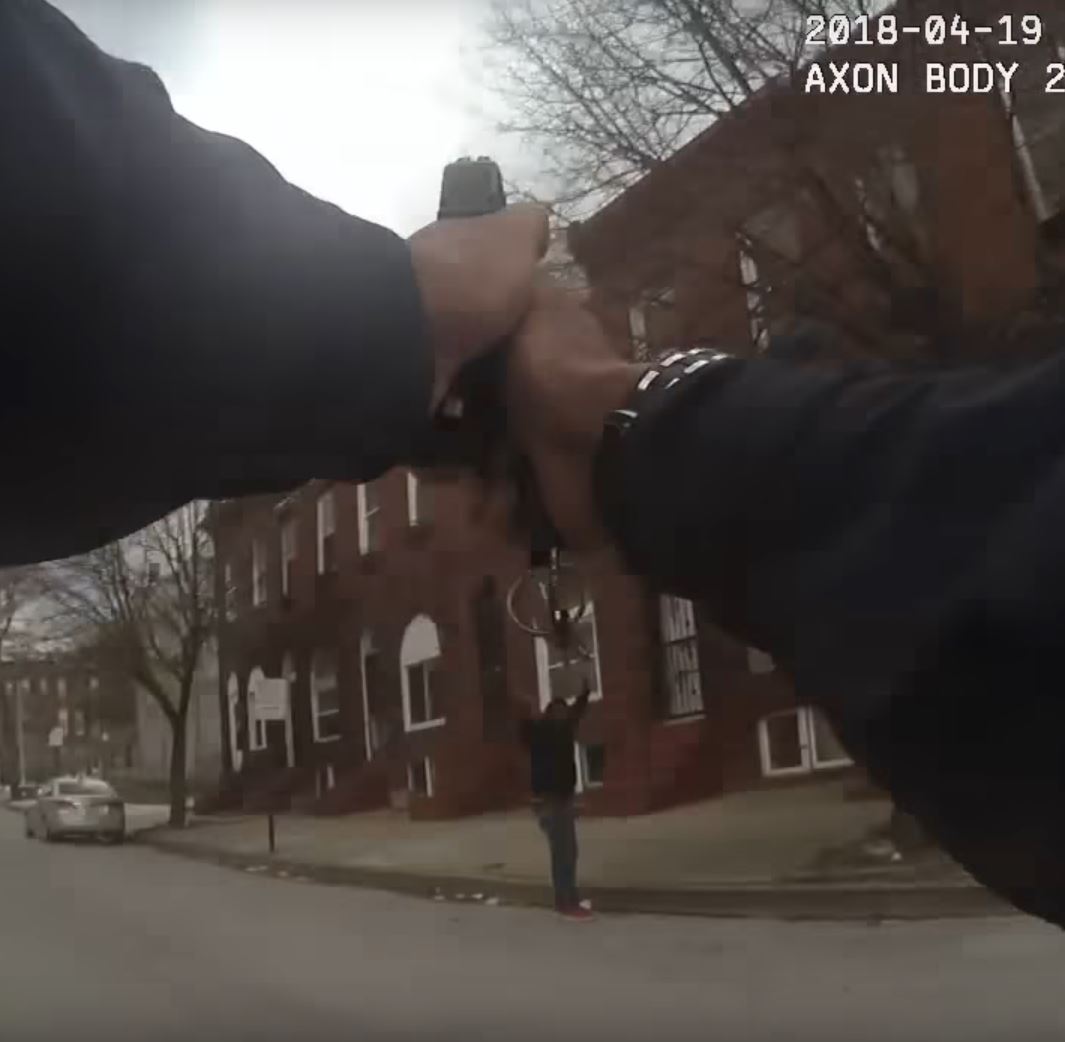
    We have this happy narrative because, as is common, the officer did not shoot the suspect when he might have. We have a happy narrative because the suspect complied with the officer’s orders. (The manner in which the suspect complied — quickly and completely — makes me seriously consider that the suspect isn’t the actual shooter. But I don’t know. He has been charged. Presumably gunshot residue on his hands answered this question.) But mostly we have a happy narrative because, despite all the haters, police in Baltimore and elsewhere are still out there, putting themselves in danger, trying to do the best they can in spite of it all.

    As to the original call, the landlord-tenant dispute? It ain’t going to close itself. At some point the dispatcher is going to need Officer Rogers to give it a code. I’m guessing it got a David-No, for “no police services needed.”

    Timeline:

    0:34— Officer is on-scene at 1704 N Regester for a civil dispute.

    7:48— 1st shot fired.

    7:50— Officer starts running toward gunfire.

    7:53— 15th shot is fired. shooting at 7:48-53 15 shots in 5 seconds

    7:54— Officer gets on radio to report shots fired

    8:00— Officer sees man in alley off to the left

    8:08— Tell man to get drop the gun and get on the ground.

    8:10— Suspect complies

    8:18— Suspect is on ground in prone position

    8:27— Officer: “My location…”

    8:28— In all the excitement, the officer forgets his location. In his defense, he does appear to be out of sector (331 officer on 321 post). But still. Always know your 20. During the next 20 seconds, given he’s out of breath and already said “shots fired,” the dispatcher should be sending officers in the direction of 1700 N Regester, the location of his call. Little things like that matter. A good dispatcher can save an officer’s life.

    8:50— Officer gives his location.

    9:26— Finally, the sweet savory sound of clicking handcuffs.

    9:44— Man with dog walks by and says good job or something.

    9:49— Backup arrives, one minute after location is announced.

    10:35— Officer: “Check that alley…. This dude, I’m up there handling a landlord-tenant dispute. Then all the sudden people start shooting. Shooter’s down right here. This dude I believe is the shooter. He just took his hoodie down. He might have dropped the gun in alley cause that’s where he ran.

    13:23— Radio: “One of the victims has a firearm in his waistband.” We later learn (at 18:34) that this gun is a revolver. It’s not clear if the revolver was fired at all. Either way, that leaves a semi-automatic belonging to the shooter who didn’t get shot, and fired somewhere between 9 and 15 rounds.

    13:30— Officer: “Why was you in the alley? And you just happened up here when the shooter came out, right?” Suspect: “Bro, I was walking up the alley to walk up North Avenue, bro, and I heard some shit. That’s why I started running.”

    14:41— Officer tries to get somebody to watch the suspect so he can review his bodycam footage.

    16:28— Shift commander: “What hundred block of Lafayette is Register at?” Uh, in the 1700 block, Baker-09. Where it’s always been.

    30:08— The suspect assures officer he wasn’t doing nothing.

    30:18— Finally, a kindly homicide detective agrees to watch the suspect the officer can return to his car to check his bodycam footage. “I’m not leaving till you do,” she says.

    30:20— Officer: “I swear. One simple thing. Ask one person to watch him so I can review the bodycam footage so we can close this. But nobody is listening to me. I’m only the one that chased the goddamn dude.”
  • The Freddie Gray Effect in Baltimore

    The Freddie Gray Effect in Baltimore

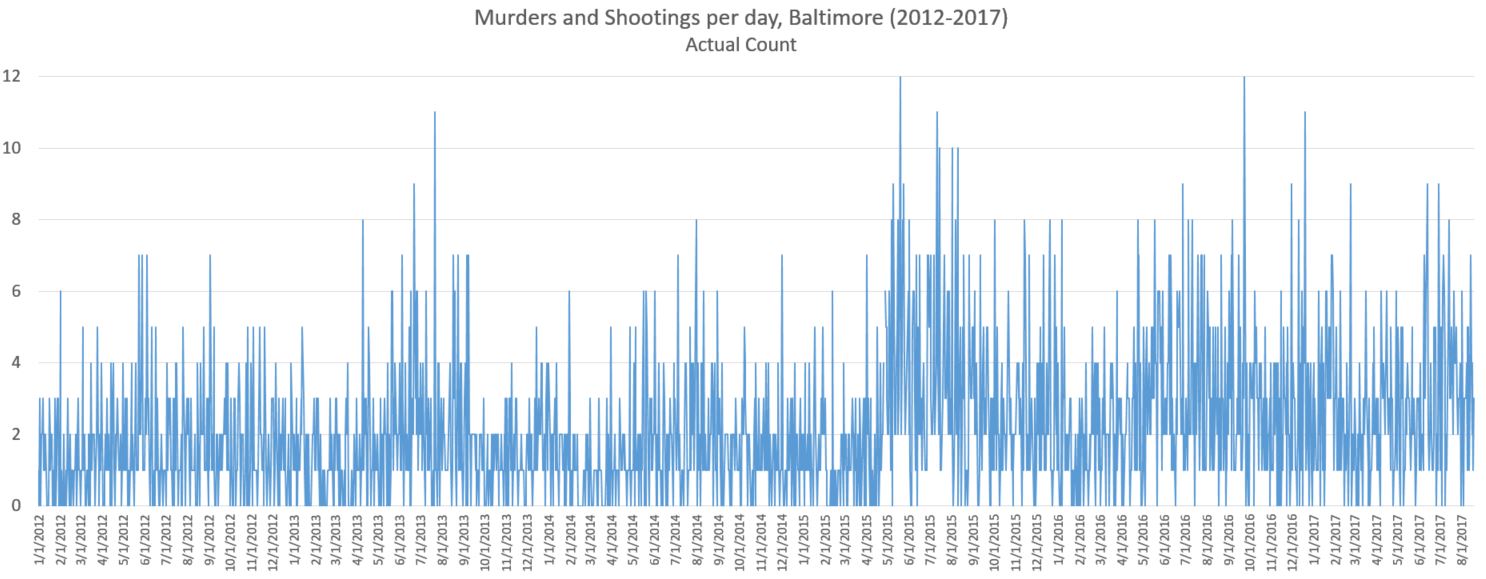
    Building on my previous post on data presentation, I did some grunt work to get a count of murders and shootings for each and every day since January 1, 2012. (If you think that’s easy or [that] can be readily downloaded, you’re wrong. Update: I could have saved a few hours of grunt work had I thought of using the  =VLOOKUP function in excel to fill in missing dates that had no major crimes.)

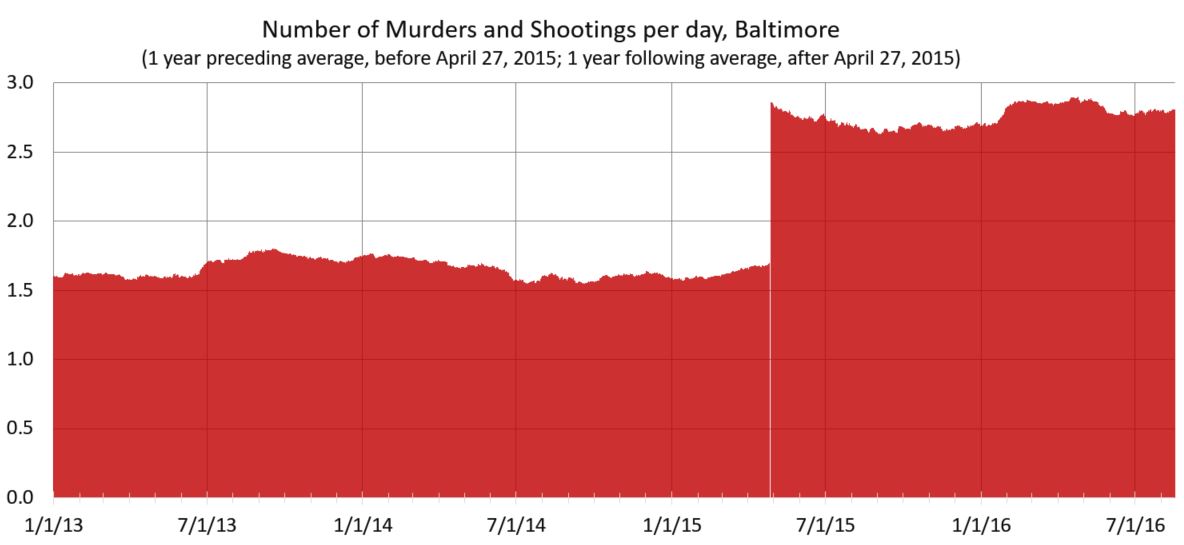
    If you simply chart the data, you get this kind of chart, which might be cool in an abstract expressionist blurry kind of way, but it’s next to worthless as a form of data presentation.

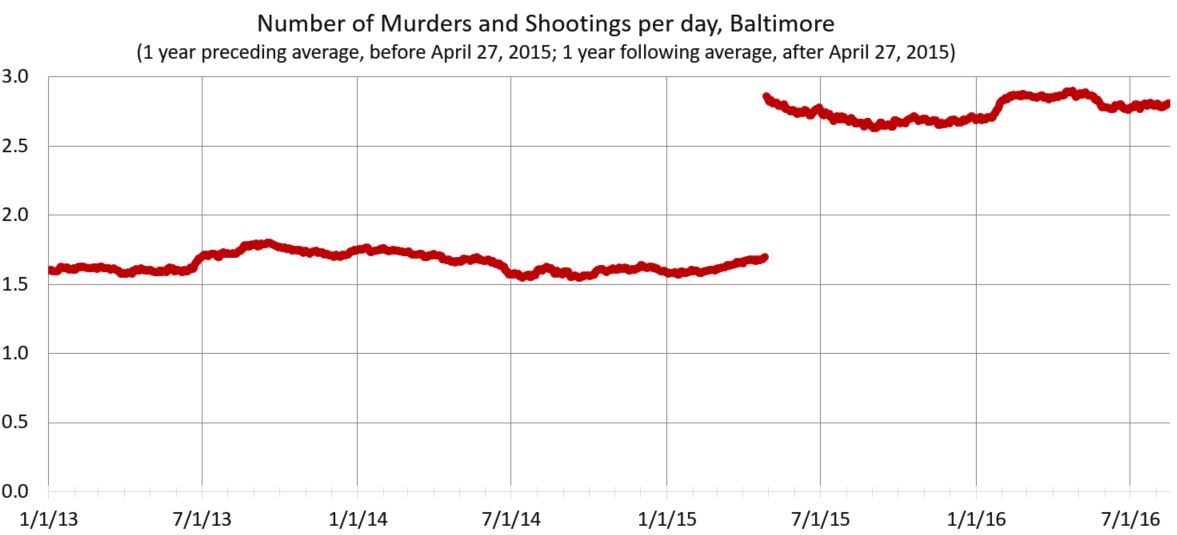
    Here’s the same data, given a bit of love and handling. For all the reasons mentioned in my previous post. I went back to a one-year moving average, split on April 27, 2015, the day of the Baltimore riots. (Pre-riot takes the average from preceding year; post-riot from the year following.) What I’m trying to highlight, in an honest way, is the large spike in murders and shooting immediately after the riots and Mosby’s decision to bring flimsy criminal charges against six Baltimore City police officers.

    Unlike other crimes, shootings and homicides are reported quite accurately. Other crimes will rise and fall in sync. (And if the data doesn’t show that, consider those data flawed, particularly in terms of less accurate reporting.) And if you’re more partial to a line graph:

    The riots were a big deal, but nobody died. More important to policing and public safety was what happened after the riots. Nobody was holding the tiller. The department was basically leaderless. The mayor had been almost in hiding. Then Mosby made the biggest mistake of all. She criminal charged six officers for doing their job — legally chasing and arresting a man running from an active drug corner (this man, Freddie Gray, then died in the police van and that led to riots). Mosby got no convictions because she had no case. She couldn’t prove a crime, much less culpability. She would later say, “I think the message has been sent.” Police got the message: if you do your job and somebody dies, you might face murder charges. Activists and Baltimore’s leaders pushed a police-are-the-problem narrative.

    Police were instructed — both by city leaders and then in the odd DOJ report city leaders asked for — to be less proactive since such policing will disproportionately affect minorities. Few seem to care that minorities are disproportionately affected by the rise in murder. Regardless, police were told to back off and end quality-of-life policing. So police did. But, unlike the arrest-’em-all strategy formulated by former Mayor O’Malley (which worked at reducing crime a little) discretionary enforcement of low-level offenses targeting high-risk offenders reduced violence a lot. It also sent a proper message to non-criminals that your block and your stoop were not going to be surrendered to the bad boys of the hood.

    Of course these efforts will disproportionately affected blacks. In a city where more than 90 percent of the murderers and murder victims are black, effective anti-violence policing will disproportionately affected blacks (Of course, bad policing will, too). The rough edges of the square can be sanded down, but this is a square that cannot be circled. Reformers wanted an end to loitering and trespass arrests. Corner clearing basically came to a stop. Add to this other factors — fewer police officers, the suspension of one-person patrol units, poor leadership — and voilà: more violent criminals committing more violent crime.

    Murders and shooting increased literally overnight, and dramatically so. Of course this took the police-are-the-problem crowd by surprise. By their calculations, police doing less, particularly in black neighborhoods, would result in less harm to blacks. And indeed, arrests went way down. So did stops. So did complaints against policing. Even police-involved shootings are down. Everything is down! Shame about the murders and robberies, though.

    Initially this crime jump was denied. Now we’re supposed to think it’s just the new normal for a city in “transition.” How about this narrative: police and policing matter; and despite all the flaws in policing at a systemic and individual level, police and policing are still more good than bad, especially for society’s most at risk. There is no reason to believe that the path to better policing much pass through a Marxist-like stage of “progressive reform” before improving. We pay police, in part, to confront violent criminals in neighborhoods where more than 20 percent of all men are murdered. We own this to those, all of those, who live there. To abdicate police protection in the name of social justice in morally wrong.

    And lest you think this rise in crime is only a problem in Baltimore, be aware that over the past three years, homicide is up dramatically in America, almost everywhere. Not just Baltimore and Chicago. Unprecedentedly so, in fact.

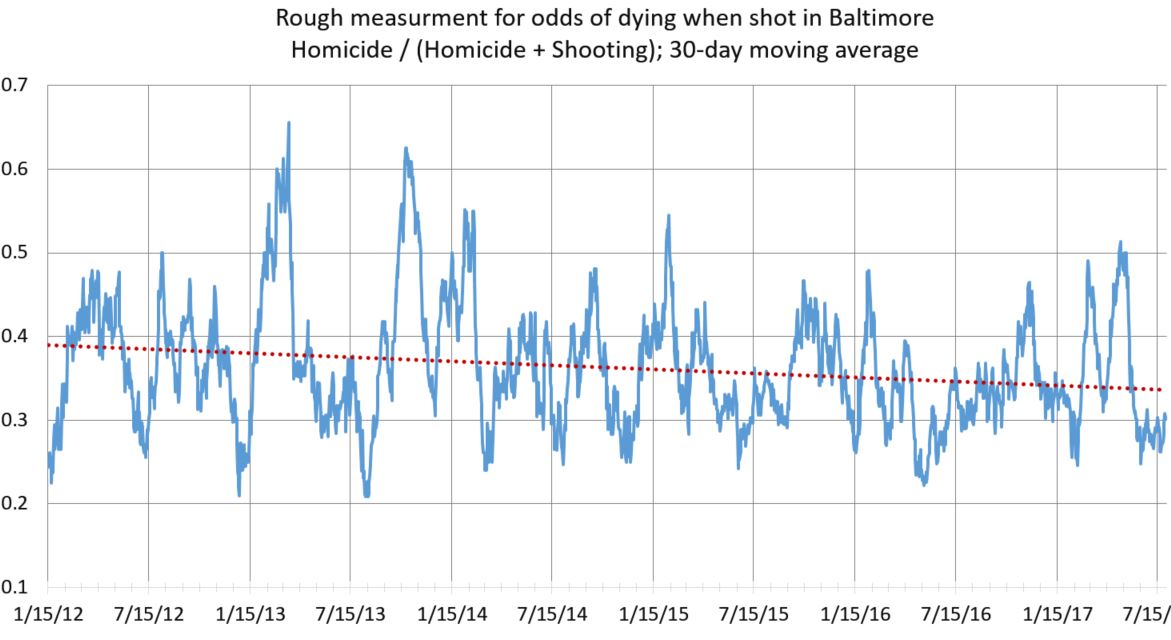
    In related news, the odds of dying if shot in Baltimore have gone down slightly since 2012, presumably because of better medical care. It’s a crude measure, but notice the downward slope of the trend line. The chance of dying has gone down from 39 percent to 34 percent. Also note the seasonal changes in mortality. I don’t know why that is.

  • Prelude to a post

    Prelude to a post

    Homicide is going up. It’s been going up for two years. And yet educated people still act shocked.

    I’m tired of refuting the homicide-increase deniers, but their arguments comes down to these collectively nonsensical points: A) homicide isn’t up in every city; B) homicide is up a whole lot in some cities; C) the increased risk of homicide isn’t spread equally among society but disproportionately concentrated among poor young black males with access to guns living in neighborhoods with historic and systemic issues of racism and segregation; and D) homicide is still lower than what it was when it was really high. To which I say A) statistically speaking, that’s why we look at averages; B) indeed, that’s a big problem, but it doesn’t negate the general increase; C) no shit, Sherlock, same as it’s ever been; D) ah, go fuck yourself!

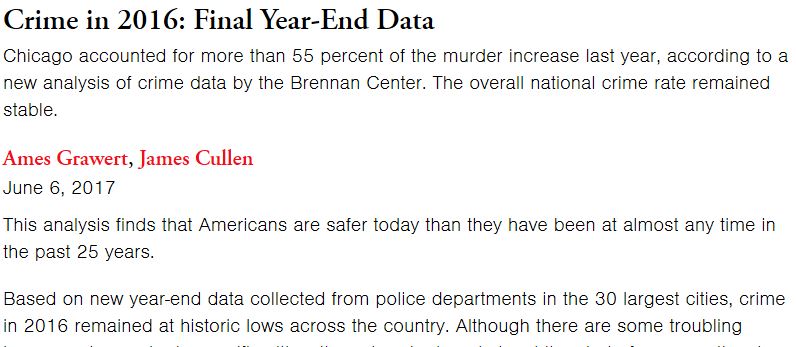
    You see, writing about this same old topic has made me cranky because I can’t believe I still have to. And I’m disappointed that so-called progressives waste time building a denialist house of cards instead of rolling up their sleeves and doing something to prevent poor black men (disproportionately) from getting murdered. But for whatever reason, a few years back, many of the left ceded crime prevention to conservatives. Somehow I missed the meeting where we decided that the only important criminal justice issues were to be police misconduct and the use of lethal force against African Americans (well, that and Mass Incarceration). And when generally respectable institutions like the Brennan Center make false statements about murder — repeatedly — we’ve got a problem.

    To wit:

    • Alarmingly, Chicago accounted for 55.1 percent of the total increase in urban murders.
    • A similar phenomenon occurred in 2015, when three cities — Baltimore, Chicago, and Washington, D.C. — accounted for more than half (53.5 percent) of the increase in murders.

    Since 2014, violence has increased. And it’s increased a lot. But Chicago neither accounted for “55 percent of the murder increase last year” nor “55.1 percent of the total increase in urban murders”! To say so once might be a mistake. To say it a few times might reflect statistical idiocy. But to do so again and again? I don’t get it. If forced to confront this false statement, they’ll probably end up saying, “it was poorly worded and we meant 55 percent of the total of the cities we looked at.” [Update: yup.] But regardless, it makes no statistical sense. Talking about the percent of total change one city makes in a small sample is bullshit, statistically and morally. Because it’s possible to pick a sample in which Chicago is 100 percent of the increase. I don’t think they’re idiots. But if not, are they trying to deceive? Or do they just get there by accident? If Chicago’s increase of 254 accounted for 55 percent of the murder increase last year, that would mean a total increase of 208 murders outside Chicago last year, nationwide. The actually increase in murders in 2016 is probably 2,000 more than 2015. And 2015 was 1,500 higher than 2014.

    Second, in 2015, Baltimore, Chicago, and DC accounted for nothing close to half of the increase in murders. The national increase (2014-2015) was around 1,500. 255 is 17 percent of 1,500, not 53.5 percent. So how do they come up with these numbers? I’ve figured it out. Put it this way, if your sample only included Baltimore, Chicago, and DC, you could say these cities accounted for 100 percent of the increase in murder. Add a few cities, and that’s basically what they’ve done.

    There’s a method to what, when, and why they do what they do. They don’t just pull number from thin air. They use faulty methods until they get a number they can replicate. And then they just put it in words, knowing nobody ever checks these things. Either that or the authors are complete statistical idiots, but I doubt that.

    Baltimore just finished the first half of 2017 with 170 homicides, the most since 1992, when the city had 115,000 more residents.

    An assistant city health commissioner who oversees anti-violence initiatives was jumped and robbed in downtown Baltimore on his way back to work after having a sandwich for lunch. In the hospital, skull fractured, he said, “I think we need to look into what is causing people to engage in this kind of behavior.” No. Actually, we don’t. Cause I’ll tell you the cause: bad or absent parenting on top of 500-years of systemic racism combined with 20th-century government programs designed to segregate and limit the ability of blacks to succeed. I can speak the liberal shibboleth. I even believe the liberal shibboleth! So what? Now what? One can and should acknowledge history, but that won’t change it. And the greater point, at least when it comes to crime and violence, is that none of this is new. Somehow, despite social injustice and white supremacy, crime and violence had been going down for basically 25 years. The violence problem has gotten worse just in the past two years. Talking about historic social issues, as important as they are, is nothing more than a distraction to avoid dealing with today’s issues of criminals and wrong-doers.

    Crime wasn’t supposed to go up, of course. Crime reduction, say some, is just part of the grand social justice and intersectionality equation. DOJ reports (on policing in Baltimore, for instance) focused exclusively on improving police, necessarily as that is, and ending racially disparate policing. They managed this without even talking about crime prevention and racially disparate rates of violence. This recent crime rise needn’t and shouldn’t have been politicized, but, as I warned, if the left won’t even acknowledge an increase in violence (disproportionately among poor black men) we effectively cede any crime “solution” to the “Trumpian right.” So now we get BS talk crime and terrorism, like somehow crime and terrorism is mostly due illegal immigrants and Muslim grandmothers. So yeah, I’m cranky in my middle age.

    But the past two years, 2014-2016, has seen the largest two-increase in homicide, in, well, probably ever. And the response of otherwise smart people is either to A) scratch their head and go, gosh, gee, maybe it’s poverty and guns and historic policies of racism. Except those haven’t changed in the past two years. Or B) it’s not a problem because, well, homicide is really up in Chicago? I don’t even know how to counter that. If you care more about right-wing overreaction to murder than the lives of those murdered, you win. Don’t care. But for people with a conscious that trumps ideology, read on.

    Here are the cities I looked at: Albuquerque, Atlanta, Austin, Bakersfield, Baltimore, Boston, Charlotte, Chicago, Cleveland, Columbus, Dallas, Denver, Detroit, Durham, El Paso, Fort Worth, Fresno, Hampton Roads (Norfolk, Newport News, et al), Houston, Indianapolis, Jacksonville, Kansas City, Las Vegas, Long Beach, Los Angeles, Louisville, Memphis, Miami, Milwaukee, Minneapolis, Nashville, New Orleans, New York, Oakland, Oklahoma City, Omaha, Philadelphia, Phoenix, Pittsburgh, Portland, Raleigh, Richmond, Sacramento, San Antonio, San Diego, San Francisco, San Jose, Seattle, St Louis, Tucson, Tulsa, Washington, Wichita.

    I got the homicide numbers best I could for each city going back as far as possible. It’s a lot of grunt work (but actually a bit easier than it used to be, thanks to journalists keeping track).

    For those cities, 2013 was the least violent year ever, with a collective 4,900 homicides. It could have gone lower; God did not ordain an urban homicide rate of 9.8 be the bottom below which no more lives could be saved. Generally, overall, homicide had been decreasing for 25 years. It could have continued to go down. But alas, people decided that police were the problem. And the problem to bad policing wasn’t better policing but less policing. How’d that turn out?

    I’ll push the data in the next post.

    [Posts in this series: 1, 2, 3, 4, 5, 6]

  • “The corrupt and brutal ones always work together as if pulled by some magnetic force”

    “The corrupt and brutal ones always work together as if pulled by some magnetic force.” (Perhaps said by a Chicago cop, but I can neither cite nor verify.) I think the reason why, might be as simple as the fact that nobody likes to be given the stink-eye by their colleagues. So if most people disapprove of what you do, you eventually get drawn like-minded folk who appreciate your work ethic and style. In the police world, for the more aggressively inclined, this means a specialized unit that focuses on arrests for drugs (and guns and maybe vice). And then, in precious semi-isolation, you feed and build on the habits of those most similar to you.

    I wrote about the federal indictment of seven Baltimore City police officers yesterday (the actual indictment is here) and said: “This is about bad apples. But it’s not just about bad apples. There’s the barrel that allows these apples to rot.”

    Who else is to blame? How do we prevent this from happening again? Who said, “Crime is up! Get me guns! And take all the overtime you need”? Who ignored complaints because the “numbers” were good?

    I don’t have the answers. But these are sincere questions. Because true organizational change best happens from within. Things sure didn’t improve when innocent Baltimore copswere criminally charged after the death of Freddie Gray. And the solution sure won’t be found in some faddish mandatory training course in implicit-bias or gender-based stereotypes. Bad reform does more harm than good. Good cops will work less; bad cops work harder.

    Last year I spent a fair amount of time criticizing the DOJ’s report on the Baltimore City Police Department. And for good reason. The DOJ report was anonymously written, horribly researched, and basically per-ordained boilerplate designed to document just enough systemic bias to activate the legal trigger needed to implement a federal consent decree while simultaneously absolving current political and police leaders of any and all accountability for the current mess Baltimore is in. These so-called investigators went to Baltimore while this crap was going on and the worst they could find were some poorly written arrest reports from five years ago?

    But I also wrote this:

    Mixed in with questionable methodology, intentions, and anecdotes, there’s some of God’s awful truth in this DOJ report. Yes, the department is a dysfunctional organization that keeps going only because of the dedication of rank-and-file who do their best, despite it all.

    I tried to highlight what the report got right. I hoped things would get better, but I didn’t think they would:

    Maybethis DOB report will improve the department despite itself. Though I might be wrong, I doubt it. I suspect people will ignore [what’s wrong with the organization] and just focus on eliminating discretionary proactive policing that saves lives. If policing has taught me anything, it’s that things can always get worse. Or, as has been said: “I have never seen a situation so dismal that a policeman couldn’t make it worse.”

    It did get worse.

    I also wrote this about the DOJ report:

    Accountability ends above the civil-service ranks. Why is that? Where is the leadership and accountability on high? Nobody blames the bosses — the mayor and police commissioner in particular — for the dysfunction of the department they control.

    You think cops like working with (the very small minority of really) bad cops? Hell, no. But the system has no way to get rid of them. So you make do. You have to.

    I defend most police officers because I’ve been there. … I’ve had to work with cops I wouldn’t trust as far as I can throw.

    So fix it, dammit. Good cops want to, but they can’t.

    And thenwe get to a failed discipline process.

    [From the DOJ Report:] The system has several key deficiencies.

    It is clear that the Department has been unable to interrupt serious patterns of misconduct. Our investigation found that numerous officers had recurring patterns of misconduct that were not adequately addressed. Similarly, we note that, in the past five years, 25 BPD officers were separately sued four or more times for Fourth Amendment violations.

    You might call that a red flag.

    How much do you want to bet that one or more of the just-indicted officers are on that list? But did anybody do anything?

    You know what might help: figure out who didn’t do the wrong thing. What you have here is an inadvertent integrity sting. Now I know you’re not supposed to get credit for doing what you’re expected to do. But you might find something out from who (if anybody) in that squad didn’t abuse overtime. Whose name didn’t come up in a wire tap? Who entered the squad, had a look around, and left right away thinking, “maybe uniform patrol isn’t so bad after all”? But that’s not the way these things work.

    [Update: According to Justin Fenton in the Sun these seven were the entire squad. As to spending your career “risking your life” to protect others as a defense, this clip from Scott and Bailey comes to mind.]

    It’s not that good cops cover for bad cops as much as they stay the fuck away from them. Why? Because if you know enough to rat somebody out, you’re already in way too deep. And if you don’t know enough, well, what are you supposed to do? Go to Internal Affairs and say, “I’ve heard rumors”? And what if some of the rumors happen to be about Internal Affairs? Nope. What you do is put on blinders to cover your ass. Why? Because when the shit hits the fan, you don’t want to be anywhere near it. This is not a Blue Wall of Silence as much as a Blue Cone of Silence. And when the bad cops are off segregated in their own unit, it makes it so much easier to see no evil. If your Spidey Sense tingles, you stay the hell away.

    And the solution — and this is always the case — needs to focus on the wrongdoers rather than be collective punishment on the majority, who are good. From my book, Cop in the Hood:

    Some officers enter the police department corrupt. Others fall on their own free will. Still others may have an isolated instance of corruption in an otherwise honest career. But there is no natural force pulling officers from a free cup of coffee toward shaking down drug dealers. Police can omit superfluous facts from a police report without later perjuring themselves in court. Working unapproved security overtime does not lead to a life in the mob. Officers can take a cat nap at 4 a.m. and never abuse medical leave. There is no slope. If anything, corruption is more like a Slip ‘N Slide. You can usually keep your footing, but it’s the drugs that make everything so damn slippery.

    As to overtime, from 15 year ago:

    To control overtime pay, superiors also discourage late discretionary arrests. While a legitimate late arrest may result in a few extra hours of overtime pay, the sergeant signing the overtime slip is likely to ask details about the arrest to confirm the legitimacy before adding an extra hour or two and giving very explicit instructions to “go straight home.”

    This “rounding up” of overtime was pretty common. And I’ll even defend it as one of the only carrots a boss has to reward somebody for doing a good job. Regardless, it is a far cry from what seems to have happened here.

  • Sometimes there are good guys and bad guys

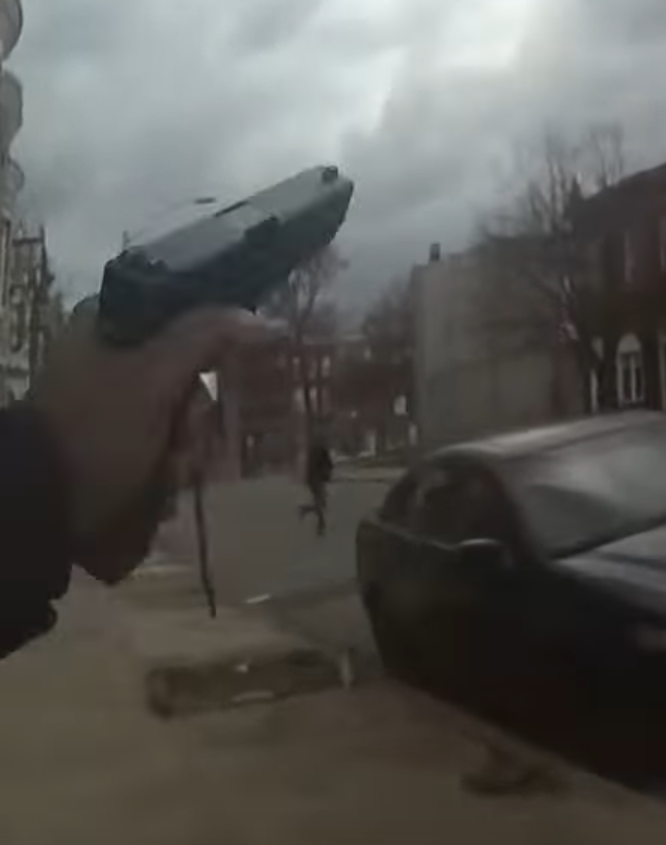
    A Baltimore police officer shot and killed an armed man who pointed a loaded gun at him.

    You’d think this would be cut and dried. But no. It’s Baltimore.

    I mean really, if any police-involved shooting is clear cut. It’s this one. Luckily for police, the cop had a body camera. Luckily it captures (barely) the key moment. Deal, a known violent offender, raises his loaded gun to shoot the cop.

    The cop, thank God, is quicker on the draw. Deal is shot and killed. And that’s where this story should end.

    But no, not in Baltimore, where officers are often criticized for doing the right thing.

    Commissioner Davis received flack at a press conference defending the cop, in part because he called Deal a “bad guy.” Why besmirch the dead? Because maybe some issues need to be presented without moral relativism. Because if you don’t point out there’s right and wrong here, people will fill in the void with an alternative facts. Also, you owe it to your officers to support them through tough times.

    [Have you killed somebody? Me, neither. But friends of mine have. And it’s not easy on them, no matter how justified and necessary the killing was. And it’s more difficult if people are saying you made a bad choice, especially when you didn’t.]

    In this case the City Papertakes aim at the cops in really one of the most idiotic police-related articles I’ve ever read. I like the City Paper. I’ve been reading it (admittedly not regularly anymore) for almost 20 years.

    According to the story, the reason you don’t know about this shooting is because “national news is at a chaotic premium right now.” Actually, no. First of all, you are reading about it cause it’s in all the papers and on the TV news.

    But what’s reckless about the City Paper story goes beyond this shooting. You may not follow this as closely as I do, but indeed, many “reformers” do not want police to be proactive at all. The story in the City Paper criticizes police for being part of the system wherein Deal ends up being shot and killed.

    Less proactive policing is the goal, the position of the DOJ report on the BPD. The DOJ asserts many things, which others may then take as Gospel because the DOJ said so. This is a real problem. The report says police shouldn’t confront/chase/arrest active violent offenders, especially if their identity is known. After all, somebody may get hurt:

    The need for the suspect’s immediate apprehension must be weighed against the risks to officers and the public caused by engaging in a foot pursuit. If officers know the identity of the suspect, his or her immediate apprehension is likely unnecessary without exigent circumstances. However, if circumstances require that the suspect be immediately apprehended, officers should contain the suspect and establish a perimeter rather than engaging in a foot pursuit, particularly if officers believe the suspect may be armed.

    Let’s talk this through.

    Man armed with an illegal gun, so you set up a “perimeter.” (Sounds cool!) How do you do that?

    What if Deal simply turns the corner and goes in a home of a friend and closes the door. (Or worse a stranger’s home.) Do you send in the militarized SWAT team? What if you didn’t see which house. Do you start banging on all the doors? That’s not really community policing. Or maybe, since you know who Deal is, you go back to the station and start filling out an arrest warrant. (Meanwhile, calls for service are backing up until the “perimeter” is called off.)

    Or what if Deal puts his gun in his waistband and runs through a vacant building into the alley. Baltimore is not like New York, where blocks are often solid with buildings and there are no alleys. But let’s say there happens to be four units at the ready (fat chance) to block off the street and sit in the rear alleys. Then what? Is a cop back there? What does she do? She was given a description of young black male, black hoodie, jeans. How does she know if it’s Deal? Does she start stopping all young black males who “match the description”? And what if Deal runs from her? Do you set up a new “perimeter”?

    And then what?

    At some point police will have to confront Deal.

    That’s why we have police. Police confront “bad guys” so we don’t have to. (Not to say Deal didn’t have any redeeming qualities, it’s just that I don’t think they’re particularly relevant in this incident.)

    Perimeter or not, assuming Deal doesn’t voluntarily put himself in handcuffs, you either chase, catch, and cuff Deal, or you police in such a manner where you do not cross his path. And if you do the latter, it would failure of the fundamental role of police in society. But when police do get the memo (or lawsuit) and police less proactively, crime goes up and people complain police aren’t doing their job. Sigh.

    I’d prefer to resolve the apprehension of an armed gunman here and now rather than have it play out for hours or days. Especially if I lived on that block. What message does it send it police let Deal walk away? Now that would be a real blow to police legitimacy.

    If there is a story here, it’s about the failure of society, and in particular Baltimore’s criminal justice system that was unwilling or unable to keep Deal off the streets. I mean, how does one even manage to get arrested and released three times in one month? Not only to you have to be a horrible criminal, you have to be kind of bad at it. Even Mosby’s often incompetent State’s Attorney’s office wanted Deal held without bail! From the Sun:

    For the third time in a month, 18-year-old Curtis Deal had been arrested on gun or drug charges. Judge Nicole Taylor wanted to be sure the young man understood what was expected if she released him to wait for trial.

    “You’re not going out at night, you’re not going to get food, you’re not going to meet your girlfriend. You’re in your house,” Taylor told him at Monday’s bail review hearing, raising her voice.

    “I’m giving you an opportunity to go to school and not be in jail pending this trial. The curfew is 1 p.m., 7 days a week.”

    Deal said he understood. Taylor wished him luck.

    The next day about 3 p.m., Deal was fatally shot by a Baltimore police detective

    It’s worth reading the whole article by Kevin Rector and Carrie Wells in the Sun. It’s a fine piece of journalism.

  • The best of times, the worst of times

    The best of times, the worst of times

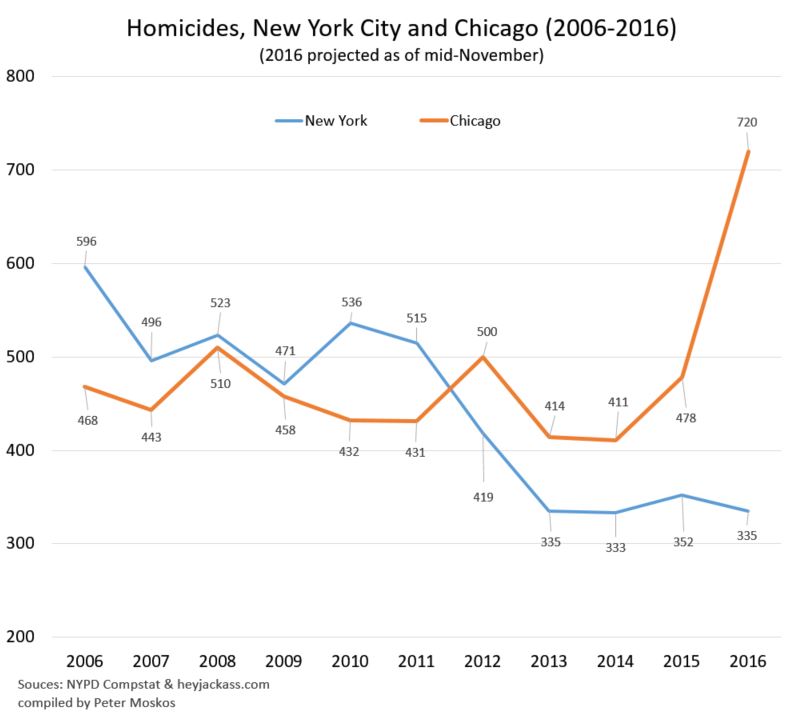
    Ah, the ol’ Tale of Two Cities trope. But the diverging homicidal paths of Chicago and New York City are striking. The New York Post has a surprisingly good (especially for the NY Post) article on homicide in Chicago and NYC.

    These are raw numbers and not a rate. Chicago is roughly one-third the size of New York City. [Notwithstanding rumors to the contrary, the national increase in murder would still be large, even without Chicago.]

    First observe NYC’s unheralded murder drop from 2011 to 2013. Police weren’t even willing to take credit! Why? Because it corresponded with the demise of stop and frisk. And then liberal Mayor de Blasio came on the scene in 2013. If you listened to cops, the city was going to immediately descend to some pre-Giuliani Orwellian hell. That did not happen.

    It turns out that quota-inspired stops and misdemeanor marijuana arrests are not good policing. Now we knew that (though even I’ll admit I was surprised that literally hundreds of thousands of stops didn’t have some measurable deterrent effect on gun violence.)

    In Chicago, stops also stopped, but unlike New York, it was not because cops stopped stopping people they didn’t want to stop. Cops in Chicago got the message to stop being proactive lest controversy ensues. Bowing to political and legal pressure, police in Chicago (and also Baltimore) became less proactive in response to the bad shooting of Laquan McDonald, excessive stop-related paperwork, the threat of personal lawsuits based on these same forms, and a mayor in crisis mode.

    Less proactive policing and less racially disparate policing is a stated goal of the ACLUand DOJ. See, if police legally stop and then frisk six guys loitering on a drug corner and (lucky day!) find a gun on one and drugs on another, the remaining four guys, at least according to some, are “innocent.” I beg to differ. (Though I should point out that in the real world, the “hit rate” never comes close to 20 percent.)

    And then there’s my beloved foot patrol. Policing is the interaction of police with the public. But there are no stats I know of to determine how many cops, at any given moment, are out and about and not sitting inside a car waiting for a call. From the Post:

    A high-ranking NYPD official credited the city’s increasing safety to the widespread, targeted deployment of cops on foot patrol.

    “Most cities only place foot posts in business districts. We put our foot posts in the most violent areas of the city, as well as our business district,” the source said.

    “It’s not a fun assignment, but it’s critical to keeping people safe.”

    Meanwhile in Chicago:

    Former Chicago Police Superintendent Garry McCarthy — who was fired last year amid controversy over the police shooting of an unarmed teen — said criticism of policing methods by local officials there had left cops “hamstrung.”

    “They’re not getting out of their cars and stopping people. That’s because of all the politics here,” said McCarthy, a former NYPD cop.

    “In Chicago, performance is less important than politics. It’s called ‘The Chicago Way,’ and the results are horrific.”

    My buddy Gene O’Donnell says:

    “The harsh reality in Chicago is that you have the collapse of the criminal justice system,” O’Donnell said.

    “The police aren’t even on the playing field anymore, and the police department is in a state of collapse.”

    O’Donnell, who was an NYPD cop during the 1980s, said that although “New York had a similar dynamic” during the height of the crack epidemic, “we had a transformation, because people realized you don’t have to tolerate that.”

    Guns are part of the mix:

    Veteran Democratic political consultant Hank Sheinkopf noted that Chicago “is much more porous to guns” than New York, with a “direct pipeline” leading there in “a straight line from Mississippi.”

    But that is more of an excuse than an explanation. Newark, New Jersey, just a PATH-train subway ride away from Manhattan, has more of a gun problem than New York City. Hard to imagine a subway and a few bridges plugs the gun pipeline.

    There are other differences between Chicago and New York in terms of poverty and segregation (greater in Chicago), commitment to public housing that actually works (greater in New York), and maybe even lower-crime foreign immigrants (greater in New York… but I say “maybe” because it’s still substantial in Chicago, with 22% foreign born).

    And then there’s this:

    Psychology professor Arthur Lurigio of Chicago’s Loyola University cited an “intergenerational” component to the mayhem, with sons following their fathers — and even grandfathers — into the city’s extensive and ingrained gang culture.

    “Chicago’s problem wasn’t a day in the making — it’s 60 years in the making,” he said.

    “Working at the jail as a staff psychologist, I’ve seen two, maybe three generations pass through.”

    I don’t mean to criticize an academic willing to highlight culture and the inter-generational transmission of violence, but I quibble with the line that Chicago’s problems are 60 years in the making. I mean, yes, it’s true…. But the explosion of homicide in the past two years is, well, a problem exactly two years in the making.

    Chicago may always have a higher homicide rate than New York because of history and structural issues. But the short-term solution is getting more cops out of their cars, back on beats, and supported when they legally confront violent people we pay police to confront.

    Violence-prevention depends, in part, on such confrontation. And since violence is racially disparate, this will mean racially disparate policing. Innocent people — disproportionately innocent black people — will get stopped. There’s no way to square this circle (though we can help sand down the rougher corners).

    The alternative to proactive policing is what is happening in Chicago. Police have responded to public and political (and legal) pressure: stops are down, arrests are down, and so are police-involved shootings and complaints against police. Police are staying out of trouble and letting society sort out the violence problem. How’s that working out?

  • White-On-White Crime (lots, but without homicide)

    [This relates to my previous post]

    Years ago, like when I was 13, I was with my father, driving from NYC to Chicago, on a baseball road trip (he drove). Between Philadelphia and Pittsburgh, we spent one night in Johnstown, PA. (Remember the Johnstown Flood!). After watching the Johnston Jonnies play baseball, we had dinner in a local bar. My father, known for being gregarious and getting along with all races, religions, and education levels, looked around at the pale depressed clientele and said to me in a hushed tone, “These are not my people.” It’s the only time I ever saw him uncomfortable in a crowd.

    Based on my last post, I looked up East Liverpool, Ohio. It’s very white (93 percent) and quite poor. The median household family income of $23,138 is about half the national average. A quarter of the population (and 35 percent of children) are below the poverty line. The population of 11,000 is down from a 1950 peak of 24,000.

    East Liverpool is the biggest city in Columbiana County, which seems to straddle coal, rust, and rural. The county has a total population of just over 100,000 people and is 96 percent white. It’s also poor, with a median family income of just $34,200 (but interestingly, the poverty rate is below the national average). And it’s increasing Republican. It’s Trump country.

    What I’m saying is, kind of like Obama and Clinton, I’ve never felt much kin with this part of America (the Appalachian Scotch-Irish folk of southeast Ohio, northern W. Virginia, and southwest Pennsylvania). If they’re more worried about immigrants, gun rights, and encroaching Sharia Law than about moving forward and letting people help them get out of poverty and not overdosing in from of their grandson, I’m inclined to let them be and not give a damn.

    But here’s the thing. No matter how hopeless and messed up things might be in East Liverpool and Columbiana County, Ohio; no matter how the jobs are gone; no matter how loose the gun laws are; no matter where junkies are shooting up; no matter how much crime there is; no matter how forgotten by the government and mocked by east-coast elites they might be, the good folks of Columbiana County somehow manage not to murder each other. And there is crime in East Liverpool, Ohio. In fact, if the data is accurate (and that is a big if, coming from a small place), the violent and property crime rates of East Liverpool are twice the national average.

    Neighborhood Scout (not exactly an ideal academic source) puts it this way:

    With a crime rate of 53 per one thousand residents, East Liverpool has one of the highest crime rates in America. With a population of 10,951, East Liverpool’s [crime rate] is very high compared to other places of similar population size.

    Best I can tell, this entire county of about 100,000 has maybe one homicide a year. Some years there seems to be none. Other years maybe two. (I’m basing this on Columbiana County, East Liverpool, and Salem City police departments). This homicide rate, 1 per 100,000, is about 1/4th the national average.

    Meanwhile, Baltimore City has a poverty rate lower than East Liverpool. Baltimore’s median household income is higher than East Liverpool. Hell, the average income even in poor East and West Baltimore is higher than East Liverpool. And yet in the past 365 days (Sep 10, 2014 to Sep 10, 2015) 329 people in Baltimore have managed to put themselves in harm’s way and get killed. Now Baltimore has more than six times the population of Columbiana County. So if Baltimore were 1/6th the size, it would have 55 murders. Columbiana County has 1.

    Even whites in Baltimore managed to get murdered 17 times last year. That’s of course a fraction of the number of black homicides, but whites in Baltimore (fewer than 200,000) get murdered eight times as often as the good folks of heroin-addicted poverty-living can’t-find-work police-are-asking-for-help Columbiana County.

    What gives?

    Baltimore City has more unemployment (7.4 percent vs. 5.3 percent). Yeah, sure. And there’s more poverty and extreme poverty in Baltimore. I’m not saying that doesn’t matter. But deep down, no. Poverty is a red herring. Culture matters. Columbiana County’s unemployment could be 20 percent and the murder rate would still be lower that Baltimore City.

    There’s something else going on. The nexus of violence is not poverty and racism but public drug dealing and drug prohibition. I suspect addicts in Columbiana County buy their heroin from friends and family and coworkers. Not from Yo-Boys on the corner. Push drug dealers inside and violence plummets. But when police try and do that in Baltimore, the DOJ complains about systemic racism.

  • It Depends What Your Definition of “Rose” Is

    What’s your definition of “rose”? Leaving aside the one that “would smell as sweet,” mine is “goes up.” I ask because the headlinein the New York Times says: “Murder Rates Rose in a Quarter of the Nation’s 100 Largest Cities.”

    When you say homicides “rose” in 25 of 100 cities, you might think it didn’t rise in 75 cities.

    Since crime rates fluctuate from year to year, we used a statistical technique to determine places where we can definitely say rates were rising.

    A “statistical technique”? What might that be? Praytell, Times, praytell. My advanced quantitative methods are rusty (and were never good), but I’d love to know what you do.

    If the data were presented in some kind of useful fashion (they’re not) you’d see something similar to Prof. Richard Rosenfeld’s solid research (pdf link). Rosenfeld looked at 56 cities and found an increase in 40.

    You can’t really tell from the Times’ crappy graphic, but in the 70 cities “Where murder rates…,” I count 27 cities where murder rates “fell slightly.” Combined with the 5 with significant decreases, that leaves 68 of the nation’s 100 largest cities where the murder rate — what’s the word? — rose. (Which is consistent with Rosenfeld’s 40 of 56.) [It’s worth mentioning that those who write the story don’t write the headlines. In the story it’s clear that murders rose “significantly” in 25 cities.]

    Now of course as a PhD, I’m supposed to use five-dollar words when fifty-cent words will do:

    Cities are obviously heterogeneous. There is tremendous variation across the largest cities in basic features such as demographic composition, the concentration of poverty, and segregation that relate to city-level differences in rates of violence.

    O.K.

    As an academic, I’m expected to endorse platitudes like:

    There is no consensus on what caused the recent spike.

    And

    Many crime experts warn against reading too much into recent statistics.

    And I should urge restraint, lest we get carried away with caring about murder. (My fear: restraint will lead to a right-wing law-and-order backlash). Also, apparently, I’m not supposed to worry about murder until more murder is up in every damn city in America. Nor should I worry about homicide because it’s been worse in the past. (An interesting argument, I note, should one apply it to poverty, racism, lead, infectious disease, or police-involved shootings. But I digress.)

    In terms of numbers (in what I would call burying the lede):

    Nationwide, nearly 6,700 homicides were reported in the 100 largest cities in 2015, about 950 more than the year before.

    That’s a 16.5 percent increase. In one year? That, my friends, is huge. Now the nationwide percentage increase will almost certainly be smaller, but the last time there was even a double-digit percentage increase in homicide was 1968. That last time the homicide numbers increased by more than 1,000 was 1991.

    Back in January, based on less data, I guessed that 2015 would see about 1,500 more murders than 2014. Gosh, am I a swamy? No, just somebody who can remove the ideological blinders long enough to use a calculator. I even offered an open $100 bet to anybody who said, “We don’t know if homicides are up.” Nobody put their money where their mouth was. Odd. It’s like they didn’t even believe what they were saying.

    If we focused on the carnage instead of arguing about reality and methodology, you see, we’d have to consider the why? And then, perhaps, we’d notice that increased violence isn’t really linked to any change in poverty or gun laws or even legitimacy. Perhaps we’d take note, as have Professor Rosenfeld and myself, that the cities where violence is most up are the cities where police have been, to put it mildly, in the news (or even charged criminally for no good reason). Perhaps crime is up because police are doing exactly what we’re asking them to do: be less proactive and have fewer interactions with the public.